Why a $200 Grinder Outperforms a $200 Espresso Machine: The Science Behind Consistent Extraction
By the Grindset team · June 12, 2026 · 6 min read
The Fundamental Asymmetry Nobody Talks About
If you walk into any specialty coffee shop and ask the barista what they'd upgrade first on a budget, the answer is almost always the grinder. This isn't tribal knowledge or brand loyalty. It reflects something real about how espresso extraction works at a physical level, and understanding it will change how you think about every dollar you spend on your setup.
The short version: a mediocre grinder paired with a decent machine produces worse espresso than a great grinder paired with a mediocre machine. Budget constraints force almost everyone to make this tradeoff at some point, and the data points clearly in one direction. But to really understand why, you need to think about what a grinder is actually doing to coffee, and why consistency at that stage matters more than pressure consistency at the extraction stage.
What a Grinder Is Actually Doing
A grinder isn't just making coffee smaller. It's fracturing a complex, porous, CO2-laden structure into particles that will be saturated with water under pressure. The particle size distribution that results from that fracturing determines almost everything about how your puck will behave. When water at 200°F (93°C) is pushed through a bed of coffee at 9 bars of pressure, it takes the path of least resistance. If your grind produces a wide, uneven distribution of particle sizes, the water channels through the fine dust and gaps between large boulders rather than permeating the bed evenly. That's channeling, and it's the primary cause of sour, bitter, and hollow-tasting espresso.
The problem isn't that large particles extract slowly and small particles extract quickly, though that's true. It's that in a pressurized environment, the extraction doesn't average out across those particle sizes. You end up with over-extracted fines contributing harsh, astringent compounds and under-extracted boulders contributing raw, acidic ones, often in the same shot. A narrow, consistent particle size distribution means water pressure is distributed evenly across the puck, and soluble compounds are released at roughly the same rate across the bed.
Where Budget Machines and Budget Grinders Fail Differently
A budget espresso machine in the $150 to $250 range typically cuts corners on temperature stability and pressure consistency. The boiler is small, the thermostat is imprecise, and you might be pulling shots anywhere from 190°F to 205°F (88°C to 96°C) depending on when you flush. That's a real problem. Brewing temperature affects extraction yield significantly, and a 10°F swing will change the flavor character of a shot considerably. These are real limitations.
But here's what those machines can still do: they can generate enough pressure to push water through a well-prepared puck. An E61 group head, even on a cheaper machine, is a fairly forgiving piece of engineering. Pressure profiling and precise PID control matter for dialing in the last 10% of shot quality. Consistent particle distribution matters for the first 60%.
A budget grinder in the same price range fails differently, and more fatally. Cheap burr geometry, poorly aligned burr sets, and motors that heat up and cause thermal expansion during a grinding session all contribute to a particle size distribution that looks less like a bell curve and more like a plateau. You get fines, boulders, and everything in between. No amount of temperature-stable brewing water fixes the channeling that results from that kind of grind.
Burr Geometry Is Not a Minor Detail
The shape, angle, and material of the burrs determine how coffee is sheared versus crushed. Flat burrs with well-engineered geometry shear coffee cells more cleanly, producing particles that are more uniform in size and shape. Conical burrs, depending on their design, tend to produce a bimodal distribution, with a cluster of fines alongside the main particle population. Neither geometry is universally superior for espresso, but both matter enormously in how they're implemented.
Cheap burrs are often made from lower-grade steel, stamped rather than machined, and held in alignment by plastic or imprecise metal housings. As they wear, alignment degrades further. A well-made $200 grinder like the Timemore Sculptor 078S or the older DF64 uses machined 64mm flat burrs with tolerances that a $50 grinder simply cannot achieve. The difference in particle distribution between these categories isn't subtle. You can measure it with a laser diffraction particle analyzer, and the results look like two completely different processes.
The Thermal Problem That Nobody Mentions
Grinder heat matters more than most people realize. When burrs heat up during a grinding session, they expand slightly, which effectively changes your grind setting. This is why some grinders produce the first shot accurately but drift finer or coarser as the session continues. In a cafe environment grinding 50 to 100 doses per hour, thermal stability is engineered deliberately into the grinder's mass and ventilation. In a home grinder with a small motor and minimal thermal mass, you're grinding a single dose from a cold state each time, which is actually favorable, but cheap motors still generate disproportionate heat relative to their grinding mass and can affect burr alignment under load.
Grind Retention and Stale Coffee in the Burr Chamber
There's another mechanical problem that cheap grinders share: high grind retention. When ground coffee sits in the burr chamber and chute between uses, it goes stale. The fines that coat the burr chamber oxidize quickly and contaminate fresh doses with off flavors. Quality grinders are designed with low-retention geometry and sometimes include partial bellows or other mechanisms to push grounds through cleanly. A grinder retaining 3 to 5 grams of old coffee in a home espresso context is essentially guaranteeing that every shot starts with a percentage of stale material. For a single dose of 18 grams, that's a meaningful contamination.
What This Means for Your Setup
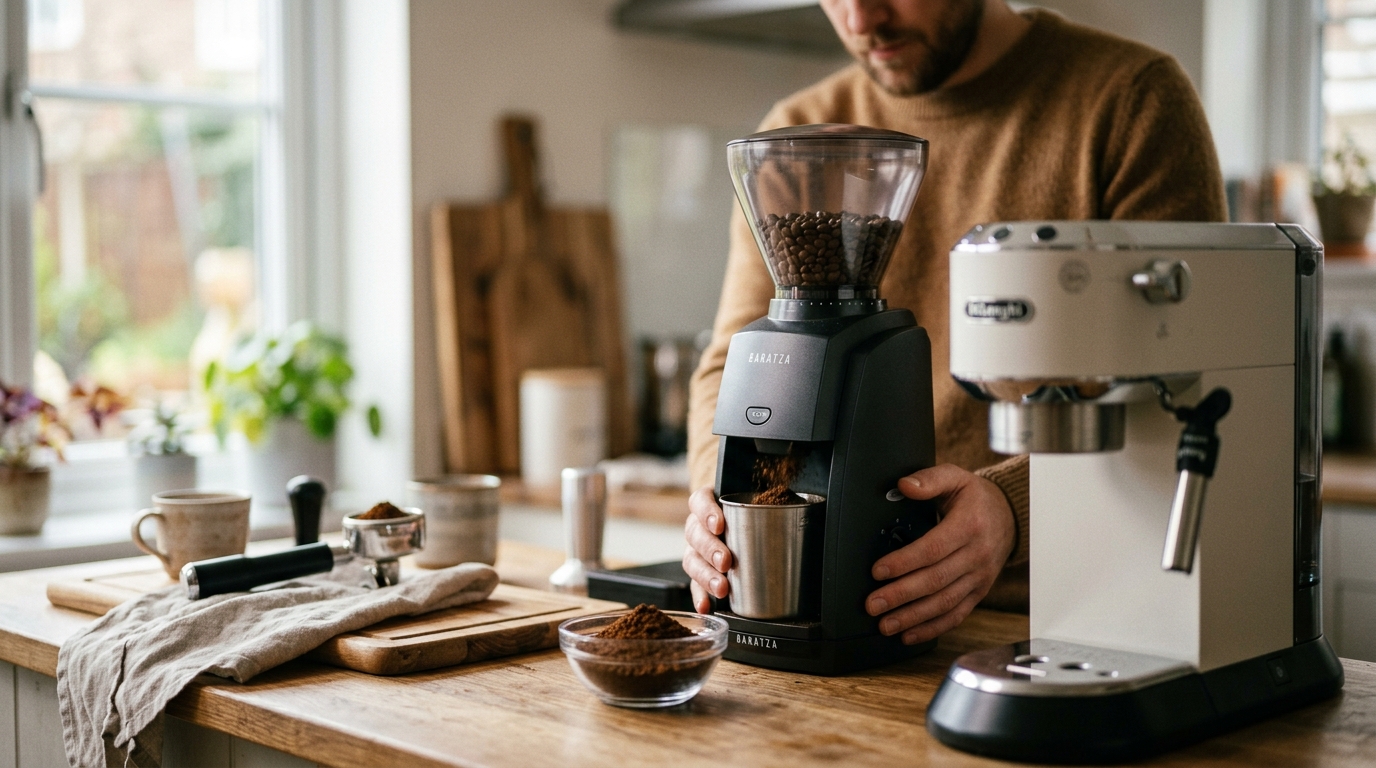
If you're working with a total budget of $400, the math is fairly clear. A $300 grinder paired with a $100 stovetop moka pot will teach you more about good coffee and produce more consistently enjoyable results than a $300 machine paired with a $100 grinder. If you're already committed to the espresso format and need a pump machine, spending $280 on a grinder and $120 on an entry-level machine is a better allocation than the reverse.
- Upgrade your grinder before adding a PID or pressure profiling kit to your machine.
- Single-dosing with a quality grinder eliminates retention issues entirely when paired with a low-retention design.
- Burr alignment matters as much as burr size. A well-aligned 58mm flat burr beats a misaligned 64mm one.
- Check the grinder's particle distribution data if it's available. Manufacturers like Weber and Lagom publish this. Treat it like a spec sheet.
The machine controls the environment in which extraction happens. The grinder controls the raw material being extracted. You can compensate for a mediocre brewing environment by adjusting dose, ratio, and temperature. You cannot fix a bimodal particle distribution after the coffee is already ground. That's why the grinder is the foundation, and why this tradeoff always resolves the same way when you think it through.
If you're tracking your shots and trying to understand what's actually changing between pulls, grindset.cafe was built specifically to help you correlate variables like grind setting, dose, and yield over time so the patterns become visible instead of invisible.