Flat Burr vs Conical Burr Grinders: How Each Affects Espresso Flavor, Grind Consistency, and Workflow
By the Grindset team · June 15, 2026 · 7 min read
The Burr Geometry Question That Actually Matters
Most grinder debates online collapse into brand wars or price comparisons, but the more interesting question sits one level deeper: what does burr geometry actually do to your espresso? Flat burrs and conical burrs are not just different shapes achieving the same result. They process coffee differently at a physical level, and those differences show up in the cup in ways that are measurable and repeatable, once you understand what to look for.
The short version is that neither design is universally superior. But each has real tradeoffs that become more or less important depending on your workflow, your palette, and the kinds of coffees you like to brew. Working through those tradeoffs carefully is more useful than picking a winner.
How Flat Burrs Work
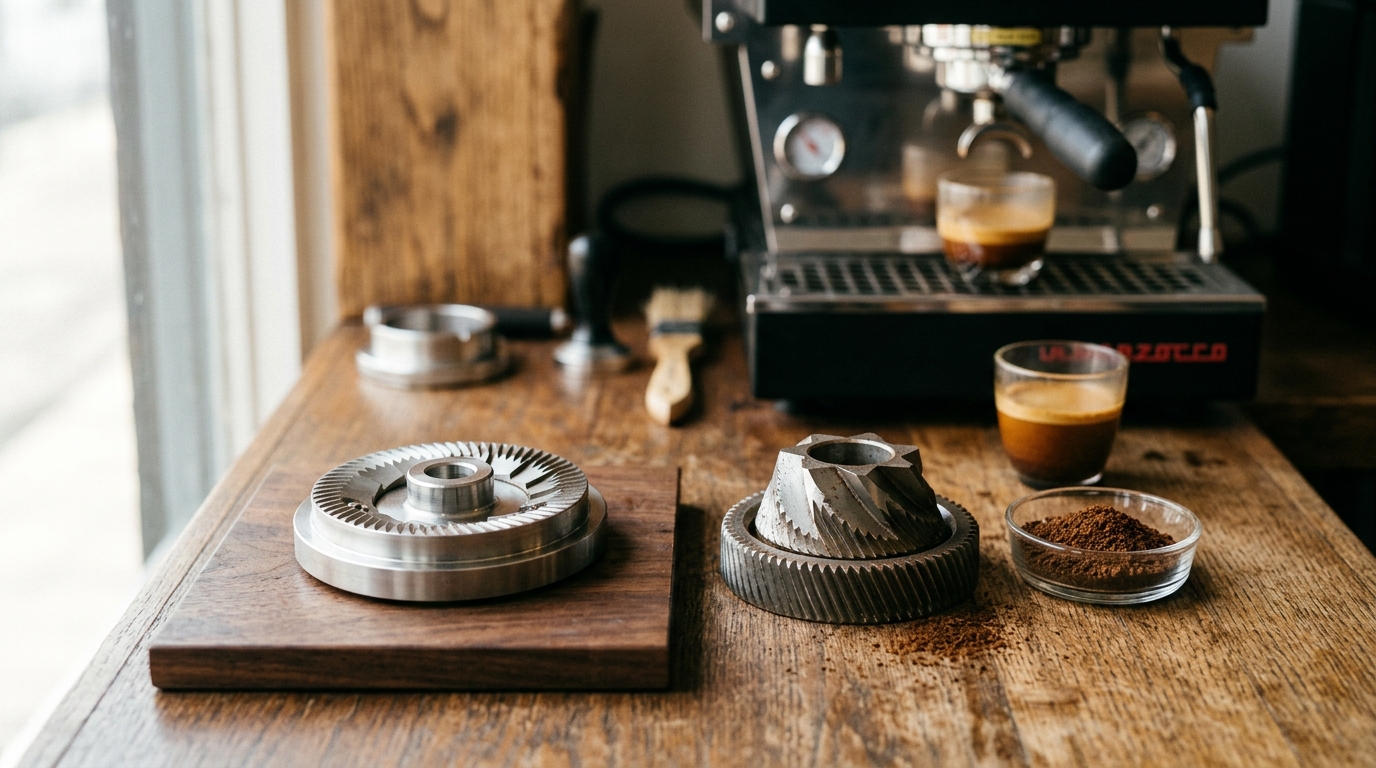
Flat burr grinders use two parallel, disc-shaped burrs that face each other horizontally. Coffee enters through the center and travels outward toward the edge, being ground progressively as the gap narrows. The key mechanical characteristic here is that the grinding zone is relatively uniform across a wide surface area, and beans spend a short, controlled amount of time between the burrs before being expelled.
This geometry tends to produce a bimodal particle distribution, meaning the resulting grind contains two distinct peaks in particle size: a larger population of coarser particles and a smaller population of very fine particles called fines. The ratio of these two populations varies by burr design and RPM, but the bimodal tendency is a consistent trait across most flat burr grinders. Whether that is a problem or a feature depends entirely on how you pull your shots.
At high extraction temperatures, around 200 to 205 degrees Fahrenheit (93 to 96 Celsius), fines can over-extract quickly, contributing bitterness if your shot runs long. But at the right ratio and with a well-designed puck, that fine population also helps restrict flow in a way that builds pressure more evenly. Many baristas working with flat burr grinders like the Mahlkonig EK43 (fitted with espresso burrs) or the Lagom P64 report that the clarity of flavor is noticeably higher, with individual fruit and floral notes coming through with less muddiness in the background.
How Conical Burrs Work
Conical burr grinders use a cone-shaped inner burr rotating inside a ring-shaped outer burr. Gravity assists feed, and the coffee spirals downward through the grinding zone from coarser at the top to finer at the bottom. This geometry means beans spend more time in contact with the burrs compared to flat designs, and the grinding action involves more of a slicing motion than the shearing action typical of flat burrs.
The particle distribution from conical burrs tends toward unimodal, meaning one dominant peak in particle size with fewer extreme fines. This characteristic is one reason conical burrs became a standard in specialty espresso for so long: they are more forgiving. A unimodal distribution creates more consistent resistance across the puck, which translates to more consistent channeling behavior and extraction that is easier to dial in without chasing edge cases. Grinders like the Mazzer Kony, Niche Zero, and the Weber Workshops Key all use conical geometry for this reason.
The tradeoff is that conical burr espresso often presents as slightly less transparent, with more body and a rounder flavor profile. This is not a flaw. For darker roasts, milk-based drinks, and blends designed for full-body extraction, that rounding effect is exactly what you want. The shot pulls together cohesively rather than exposing every individual note, which suits many commercial contexts and many home preferences perfectly well.
Grind Consistency and Retention
Beyond particle distribution, the two geometries differ in how they handle retention and consistency across a workflow. Flat burr grinders, particularly those running at higher RPMs, generate more heat per unit of grinding time. Over a long cafe service, this can shift your grind slightly as the burr chamber warms up, requiring minor dose or grind adjustments. This is not a disaster, but it is a real operational consideration.
Conical burr grinders tend to run cooler because they operate at lower RPMs and the geometry is more thermally stable by design. For home users pulling one or two shots at a time, this is largely irrelevant. For a busy cafe doing 300 shots before noon, it matters more.
Retention is another practical difference. Many flat burr grinders, especially older commercial designs, retain more coffee in the grinding chamber between doses. This creates a stale coffee problem if you are grinding to order, and it makes single-dosing difficult without purging several grams first. Newer flat burr designs, like the DF64 and several high-end options from Eureka and Baratza, have addressed this with improved exit geometry and lower retention designs. Conical burr grinders like the Niche Zero were specifically engineered around single-dosing with near-zero retention, which is part of why they became popular among home espresso enthusiasts.
What Each Geometry Does to Flavor
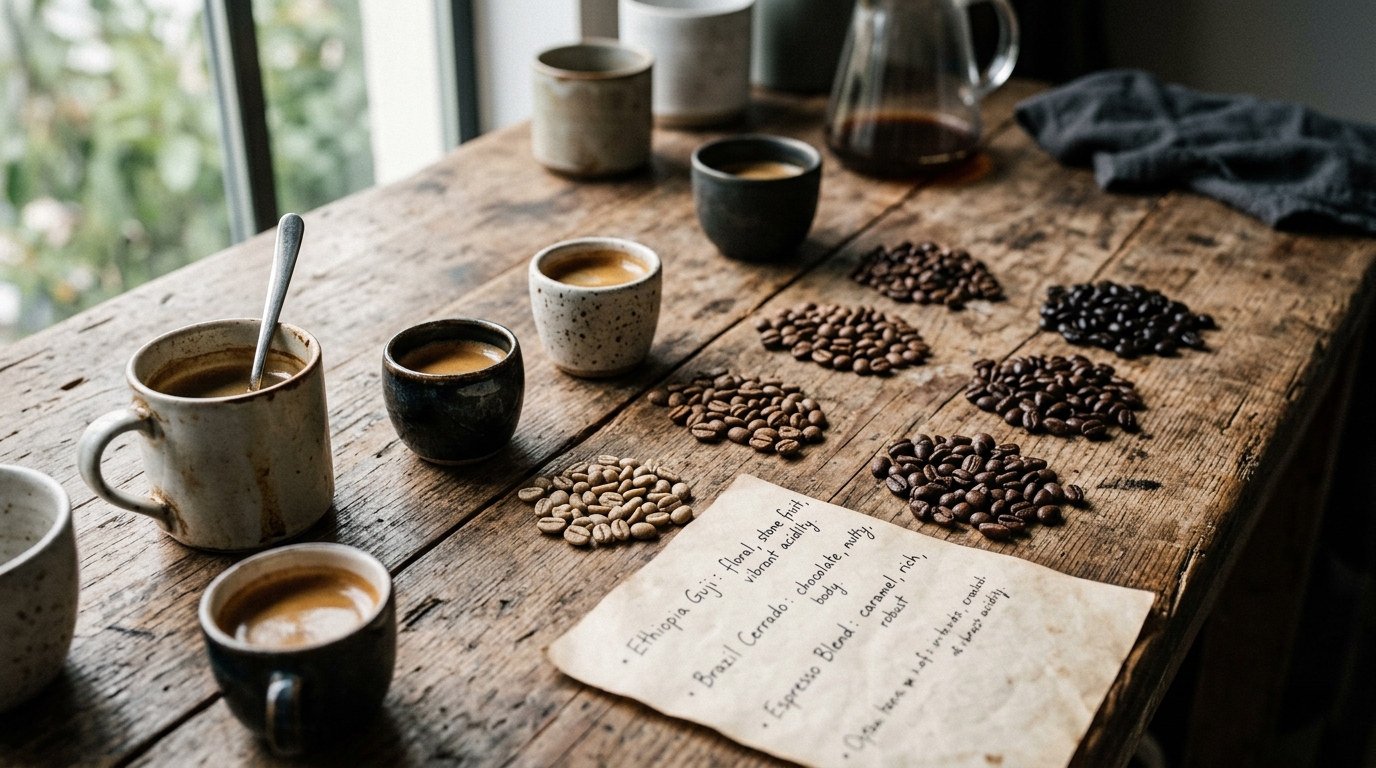
If you pull a light roast Ethiopian natural through a flat burr grinder at 93 Celsius with a 1:2.5 ratio in 28 seconds, you are likely to get something with pointed clarity: the blueberry or jasmine note sitting distinctly in the cup, with a thinner body that either reads as elegant or slightly hollow depending on your preference. The same coffee through a conical burr grinder at the same ratio and temperature will often present as slightly more integrated, with those same notes present but supported by a rounder body that connects them.
Neither version is objectively better, but the difference is real and consistent enough to factor into your purchasing decision if you know what you are going for. If you are building a workflow around single-origin light roasts and you want that fruit-forward transparency, flat burr grinders reward that intention. If you are making cortados and flat whites with a house blend or medium roast and you want reliable, full-bodied pulls without constant dialing, a quality conical design will serve you better.
For darker roasts, the conical advantage becomes more pronounced. The more aggressive fines generation from some flat burr grinders can amplify the roast-forward bitterness that dark roasts already carry, making extraction control harder. Conical burrs, with their gentler grinding action, extract dark roasts more smoothly.
Making the Decision for Your Setup
The practical factors that should drive your decision are: what coffee you mostly drink, how many shots you pull per session, and whether you are single-dosing or hopper-feeding. A home user pulling two shots of light roast each morning from a single dose will find the Niche Zero or a similar conical grinder an excellent fit. A home user who wants to push extraction on single-origins and enjoys the dialing process will likely find more reward from a quality flat burr setup, understanding that it demands slightly more attention.
- Light roast, single-origin espresso where flavor clarity is the priority: flat burr geometry tends to perform better
- Blends, medium to dark roasts, and milk-based drinks where body and integration matter more: conical geometry is often the stronger choice
- Single-dosing at home with minimal workflow overhead: look at low-retention conical designs first
- High-volume cafe environments where heat stability across a long service matters: conical burrs have an operational edge
If you are tracking your shots and dialing in systematically, the grinder's geometry becomes just one of several variables you are managing alongside dose, yield, temperature, and time. At grindset.cafe, the shot logging is built to help you isolate exactly these kinds of variables across a series of pulls so that the effect of any single change, including swapping grinders, becomes visible in your data rather than lost in impression.
The honest conclusion is that a well-designed conical grinder at 400 dollars will outperform a poorly designed flat burr grinder at the same price every time. Burr geometry matters, but burr quality and engineering matter more. Understanding the geometry gives you a framework for what to expect from each design, which makes