
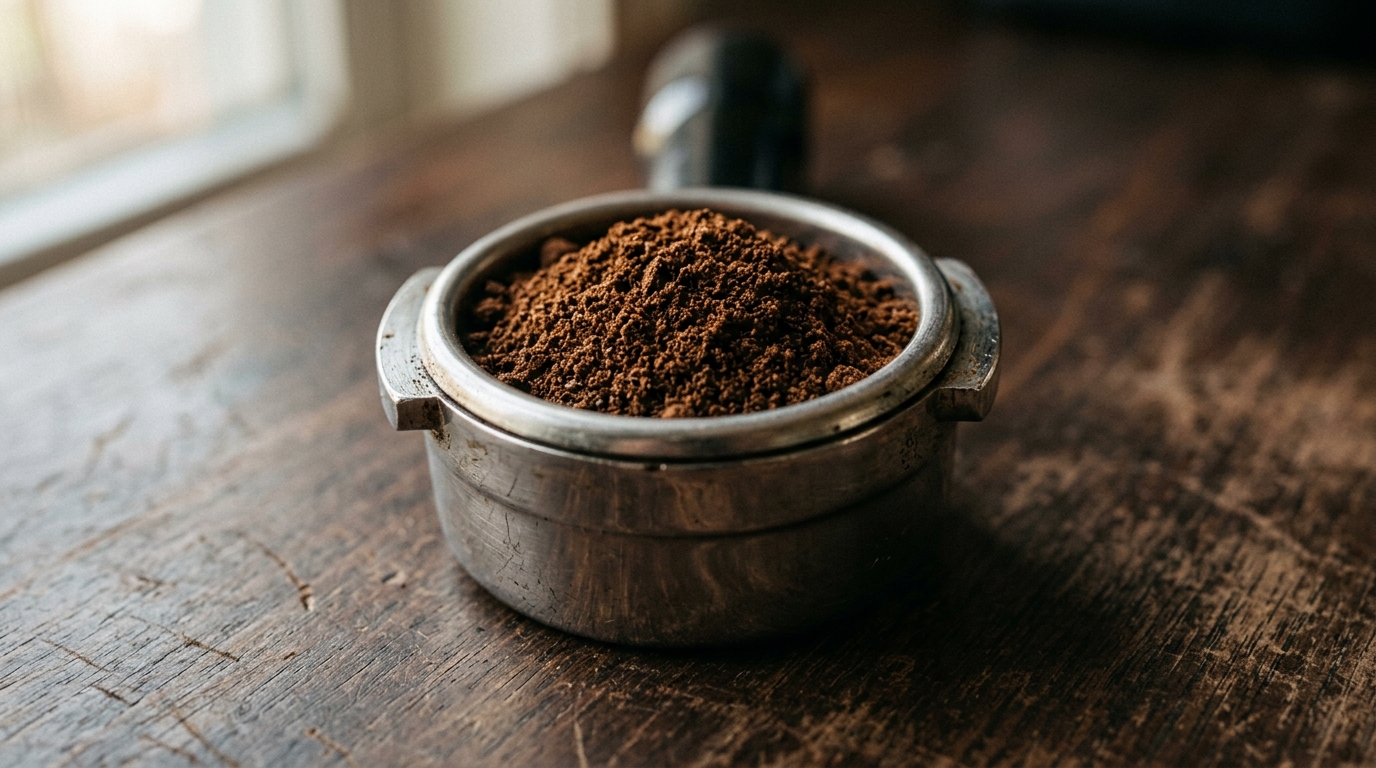
Espresso Grind Size Guide:
Coarse, Fine, Perfect
Grind size is the single most powerful variable in espresso. Understanding it is the difference between fighting your machine every morning and pulling great shots on demand.
Why grind size matters more than anything else
When hot water is forced through espresso grounds at 9 bars of pressure, it dissolves soluble compounds from the coffee. How much it dissolves depends on how long the water is in contact with the grounds — and that contact time is controlled primarily by grind size.
Fine grind = small particles = more surface area = more resistance = slower flow = longer contact = more extraction.
Coarse grind = large particles = less surface area = less resistance = faster flow = shorter contact = less extraction.
Everything else — dose, temperature, pressure — plays a secondary role. Nail the grind first.
The grind spectrum: what each setting produces
Way too fine
Time
> 45s
Taste
Bitter, burnt, no flow
Too fine
Time
35–45s
Taste
Over-extracted, bitter, astringent
Just right
Time
25–32s
Taste
Balanced, sweet, complex
Too coarse
Time
18–24s
Taste
Under-extracted, sour, weak
Way too coarse
Time
< 18s
Taste
Sour, watery, no body
* Based on 18g dose / 36g yield. Times shift with dose changes.
How to read your shot and know what to adjust
Shot ran in under 22 seconds
→ Too coarse
Do: Go 1–2 clicks finer. Even if it tastes OK, you're probably leaving sweetness on the table.
Shot ran in 25–32 seconds and tastes balanced
→ Dialed in ✓
Do: Note your settings. Same recipe tomorrow.
Shot ran in 35+ seconds
→ Too fine
Do: Go 1–2 clicks coarser. Also check for puck prep issues (channeling, uneven tamp).
Shot time is right but tastes sour
→ Slightly under-extracted
Do: Go 0.5–1 click finer. Or increase dose by 0.5g.
Shot time is right but tastes bitter
→ Slightly over-extracted
Do: Go 0.5–1 click coarser. Or check water temperature (might be too high).
Shot blondes (goes pale) very quickly
→ Too coarse or channeling
Do: Go finer. Also check your distribution and tamp for evenness.
Notes for different grinder types
Entry burr (Baratza Encore, Breville Smart Grinder Pro)
Pros
- + Affordable
- + Easy to use
- + Good for beginners
Cons
- − Less consistent particle size
- − Wider range needed to dial in
- − Takes more shots to find the window
Tip for this grinder
Move in 1-click increments. The steps are coarser. Use 18g dose as baseline.
Mid-range flat burr (Eureka Mignon, Niche Zero, DF64)
Pros
- + Very consistent
- + Repeatable
- + Lower retention
Cons
- − Requires calibration after burr break-in
- − More expensive
Tip for this grinder
After seasoning (1–2kg of coffee), zero the burrs and set from there. Moves in smaller steps.
High-end flat burr (Lagom P64, EK43, Monolith)
Pros
- + Best clarity and uniformity
- + Excellent for single-origin light roasts
- + Highly repeatable
Cons
- − Expensive
- − May require different dialing-in approach (lower dose, longer shot)
Tip for this grinder
These often work best at slightly finer settings than expected. Try 1:2.5 ratio for clarity.
Hand grinder (Comandante, 1Zpresso)
Pros
- + Excellent value for quality
- + Quiet
- + Portable
Cons
- − Manual effort
- − Not suitable for back-to-back shots at scale
Tip for this grinder
Comandante: espresso is typically in the 10–20 click range. 1Zpresso: varies by model, check manufacturer guide.
FAQ
How fine should espresso be ground?
Fine enough that a standard dose pulls in 25–32 seconds. That range varies wildly by grinder model. The texture should feel like fine sand — finer than filter coffee but not powdery.
My shot is fast even on the finest setting — what's wrong?
A few possibilities: 1) Your beans are stale and losing CO2, making them compress more loosely. 2) You need to go further into the grinder's fine range. 3) Your basket or puck prep needs work. Try fresher beans first.
Can I fix grind with dose changes instead?
Somewhat — more dose increases resistance and slows flow. But it's a band-aid. Fix the grind, then use dose to fine-tune the taste profile.
How often should I adjust my grind?
For a new bag: adjust immediately. As a bag ages (1–3 weeks in), less CO2 remains to resist water flow, so shots tend to run faster at the same setting. A click finer every few days usually keeps shot time consistent.
Log every shot. Find your perfect grind.
Grindset shows you grind size, dose, and yield trends across your shot history — so you can see what's working.
Try Grindset free