The $35 Tool That Finally Made My Home Coffee Taste Like the Café Version
By the Grindset team · July 6, 2026 · 6 min read
For years I pulled shots by feel. Measure the beans by eye, run the machine until the cup looked right, taste it, shrug, repeat. Some mornings the espresso was fantastic. Most mornings it was somewhere between flat and quietly wrong, and I couldn't tell you why. The variable I kept ignoring was weight, and once I started tracking it precisely, almost everything else about my brewing got easier to fix.
A coffee scale is not a luxury item. It is the cheapest diagnostic tool available to a home brewer, and it does more work per dollar than any grinder upgrade, any portafilter basket, any temperature surfing technique. Here is why that is true, and what specifically changes when you start using one.
Volumetric Measurement Is Lying to You
Coffee scoops and tablespoon estimates seem reasonable until you think about what coffee actually is: a roasted, porous, irregularly shaped agricultural product with a density that changes depending on roast level, variety, and how long ago the beans were roasted. A scoop of freshly roasted light roast beans and a scoop of two-week-old dark roast can differ by 20 to 30 percent in actual mass. That means you could be dosing 14 grams when you think you are dosing 18, and every other variable you try to control is now sitting on a cracked foundation.
Brew water volume has the same problem. Most home espresso machines offer some form of volumetric programming, but machine-measured volume is calculated from pump strokes, not actual liquid in the cup. Scale wear, pump inconsistency, and channeling all introduce error. The only number you can actually trust is what sits on a scale.
The Brew Ratio Is the Blueprint
Brew ratio is the relationship between dry coffee input and liquid espresso output, expressed as a ratio like 1:2 or 1:2.5. A 1:2 ratio means 18 grams of ground coffee yields 36 grams of liquid espresso. This number matters because it is one of the three primary levers controlling extraction, alongside grind size and brew temperature. When you do not know your ratio, you cannot make a meaningful adjustment to anything else.
Consider what happens when your yield is off by 10 grams. At a 1:2 target starting from 18 grams in, you are shooting for 36 grams out. If you actually pull 46 grams, you have crossed into 1:2.5 territory. The shot will taste thinner and more acidic because you have extracted more soluble compounds from the puck, including lighter organic acids that extract relatively quickly and the bitter, heavier compounds that come out later in the pull. A 10-gram deviation is not subtle. It changes the character of the drink entirely, and without a scale you will never catch it consistently.
Most single origin espressos taste best somewhere between 1:2 and 1:2.5. Traditional Italian-style blends often perform well at 1:1.5 to 1:2, producing the denser, more syrupy texture associated with that style. Neither target is reachable with any reliability if you are eyeballing into a ceramic cup and guessing.
What You Actually Need From a Scale
You do not need anything expensive. The features that matter for espresso are specific and modest:
- Resolution of 0.1 grams. One-gram resolution is not fine enough for espresso doses, where 0.5 grams can shift your extraction noticeably.
- A low-profile form factor. Many espresso drip trays leave only 30 to 40mm of vertical clearance, and a thick scale will prevent your cup from fitting underneath the portafilter.
- A response time fast enough to catch a moving weight. Some inexpensive scales update every second or slower, which makes it hard to stop a shot at the right output weight.
- Water resistance, or at least some tolerance for splashing. Espresso brewing involves moisture, and your scale will get wet.
Timer functionality is a bonus but not strictly necessary. What you need first is accurate weight. Time matters too, a well-extracted shot typically runs between 25 and 35 seconds from first drip, but you can track time separately while the scale handles the thing it is actually built for.
The Feedback Loop This Creates
Once you have a scale under your cup, you have data. And data lets you make purposeful adjustments instead of random ones. The standard troubleshooting framework for espresso becomes much more usable: if your shot is sour and thin, check whether your ratio ran long, which would indicate over-extraction of lighter compounds, or whether your grind is too coarse and your time too short, which indicates under-extraction. You cannot have that conversation with yourself reliably without knowing what your yield was.
There is also the input side. Weighing your dose before grinding means you stop relying on your grinder's doser calibration, which drifts. Most home grinders are not precise enough to hit a consistent dose by time or by click, but they are consistent enough that once you dial in 18.0 grams on the scale, you can repeat it. The scale is the reference point that makes your grinder's inconsistency manageable.
Over time, this creates a record you can actually learn from. When a shot is exceptional, you know the input weight, the output weight, and the time. You can reproduce it. When something goes wrong after a bag change or a humidity shift, you have a baseline to return to rather than starting from scratch.
Pourover and Filter Brewing Benefit Just as Much
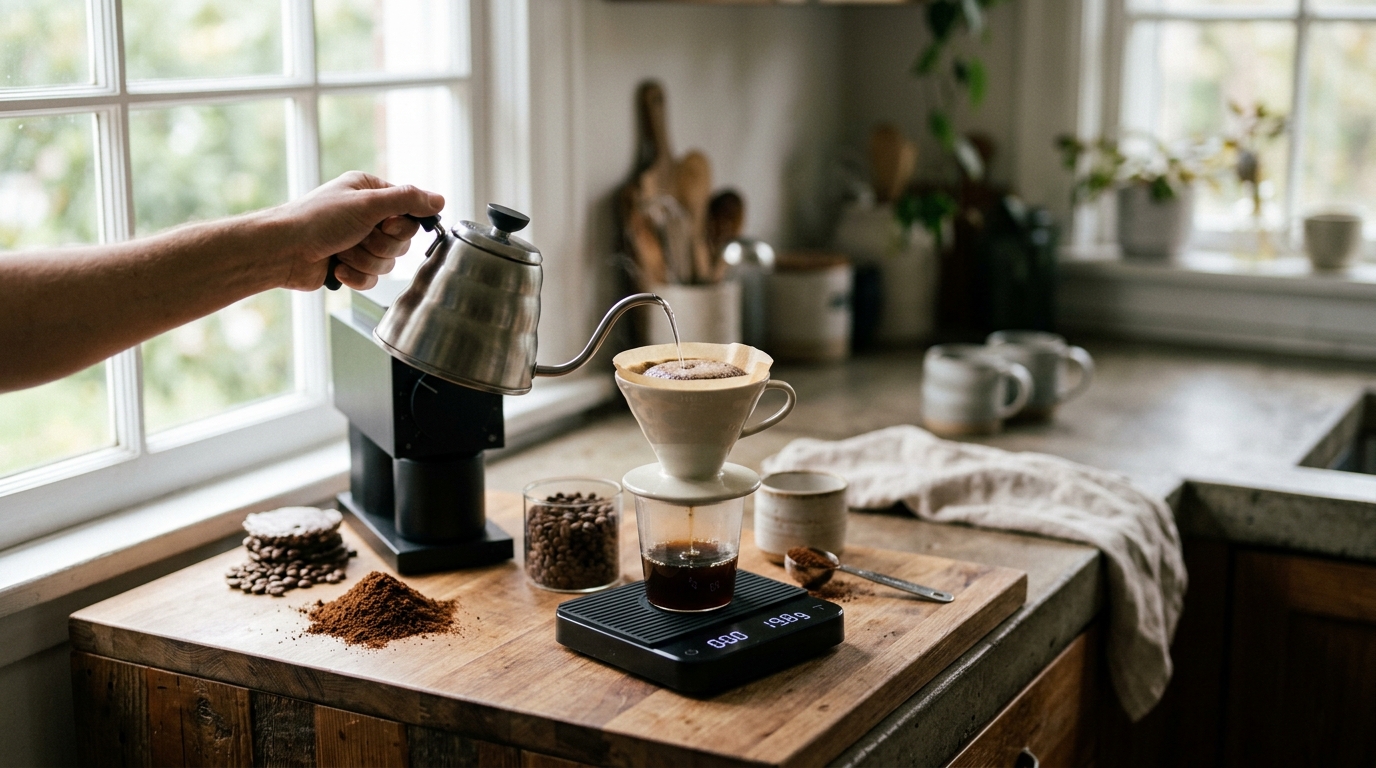
If you brew pourover, French press, or any other filter method, the scale is equally valuable. The standard recommendation for filter coffee is roughly a 1:15 to 1:17 ratio by weight, meaning 30 grams of coffee to 450 to 510 grams of water. Bloom timing, pour intervals, and drawdown all become more repeatable when you are tracking grams rather than counting seconds of pouring or eyeballing a kettle fill. One scale covers your entire brewing operation.
Thirty-Five Dollars Is the Right Investment Before Any Other Upgrade
People ask constantly whether they should upgrade their grinder or their machine first, and the honest answer is that neither upgrade will perform as well as it could if you do not have a scale to measure what it is doing. A better grinder producing more consistent particle distribution is invisible to you if your dose varies by 2 grams between shots. A machine with better temperature stability is wasted if you do not know whether your ratio is landing where you intend it to land.
The scale costs less than two bags of specialty coffee. It requires no installation, no calibration beyond taring, and no learning curve beyond understanding what a brew ratio is. At grindset.cafe, the whole point is helping home brewers build on solid fundamentals rather than chasing gear upgrades that outrun their technique. A scale is the fundamental. Everything else builds from it.
Buy the scale first. Dial in your ratio. Then, and only then, worry about whether your grinder is holding you back.