Can You Batch Prep Espresso for the Week? What Actually Happens to Taste, Crema, and Quality Over Time
By the Grindset team · July 3, 2026 · 6 min read
The Question Worth Asking
Every few months someone posts in a coffee forum asking whether they can pull a week's worth of espresso shots on Sunday and refrigerate them for quick weekday use. The responses usually split between people who recoil at the idea and people who claim it works fine. Neither camp tends to offer much in the way of reasoning. So let me walk through what actually happens to espresso when you store it, because the answer is more nuanced than a simple yes or no, and it depends heavily on what you're trying to do with it.
The short version: you can batch prep espresso, but you cannot preserve it. What you're really asking is whether degraded espresso still serves your purpose, and sometimes the honest answer is yes.
What Espresso Actually Contains (and Why That Matters for Storage)
A freshly pulled shot is a colloid, a suspension of oils, fine particles, and dissolved solids in water. The crema sitting on top is a foam of carbon dioxide bubbles stabilized by those oils and proteins. That structure is not stable. Within minutes of pulling a shot, the CO2 is escaping, the emulsion is separating, and oxidation is beginning. Melanoidins (the brown polymers formed during roasting via Maillard reactions) are relatively stable, but many of the aromatic volatile compounds that give espresso its complexity are not. Aldehydes, esters, and sulfur-containing compounds begin degrading rapidly on contact with oxygen and heat.
Refrigeration slows these reactions but does not stop them. The Arrhenius equation governs reaction rates in chemistry: lower temperature reduces the rate exponentially, but never to zero. A shot stored at 38 degrees Fahrenheit (3 degrees Celsius) will degrade much more slowly than one sitting on a counter at 70 degrees Fahrenheit (21 degrees Celsius), but it will still degrade. The aromatic volatiles that dissipate fastest are precisely the ones responsible for the bright, high notes in a well-extracted shot.
Crema Is Gone Immediately, and That's Fine
Crema will not survive refrigeration. It will not even survive 10 minutes at room temperature with any integrity. The foam collapses as CO2 escapes and the oil-water emulsion destabilizes. If crema matters to you aesthetically or as a proxy for shot freshness, batch prepping is not going to work and no amount of clever storage will change that. However, crema's actual contribution to flavor is contested. It contains bitter compounds alongside pleasant ones, and many experienced tasters find that shots taste cleaner after the crema is stirred in or has dissipated. For drinks mixed into milk or diluted for iced espresso, crema is functionally irrelevant.
What Refrigerated Espresso Tastes Like After 24 to 72 Hours
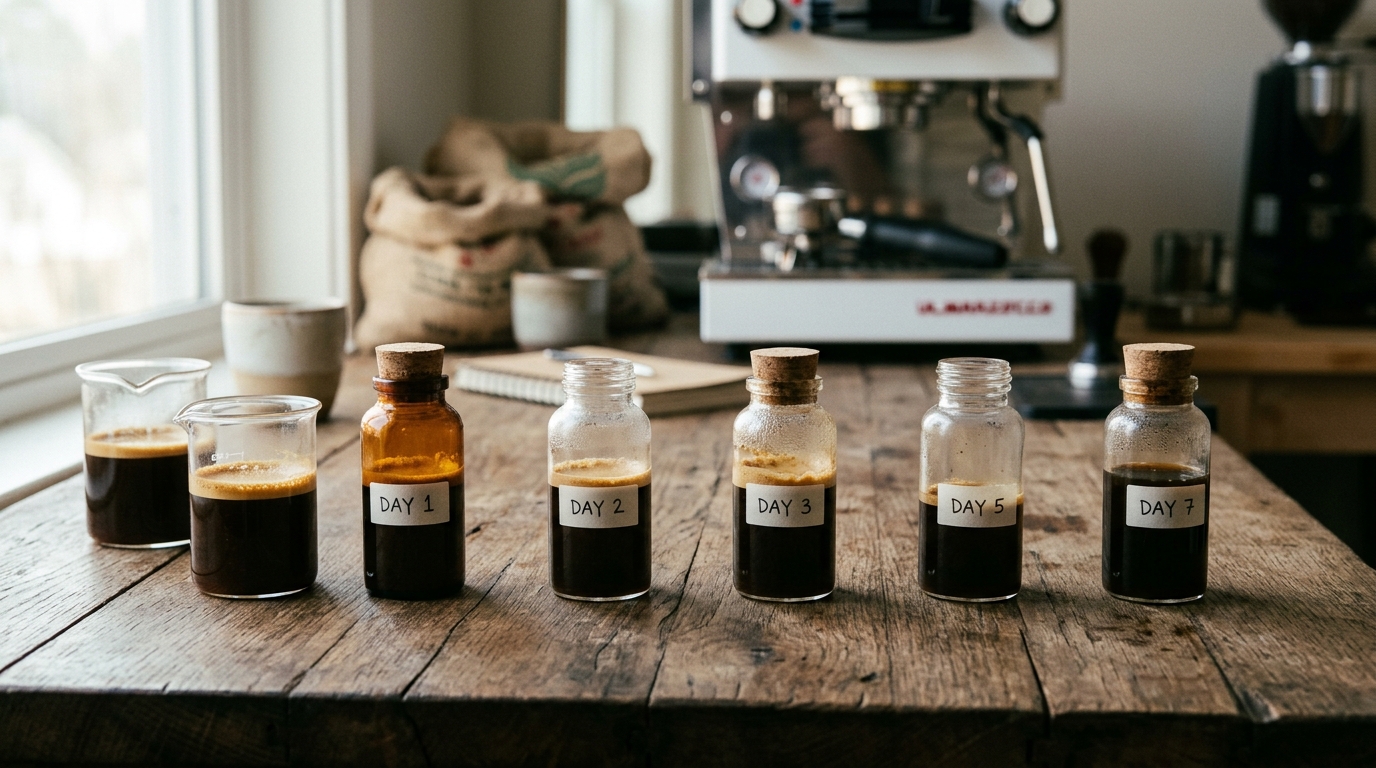
I've tested this in my own kitchen with a range of roasts and extraction parameters. Here is what I observed consistently. In the first 12 to 24 hours refrigerated in a sealed container, the shot loses most of its high aromatic complexity. Floral and fruit notes drop off significantly. What remains is the body, the sweetness, and the roast-driven characteristics. Bitterness often becomes more prominent, partly because the compounds masking or balancing it have degraded and partly because oxidation produces additional bitter byproducts. A shot that was bright and nuanced when pulled might taste flat, slightly stale, and more bitter at the 24-hour mark.
By 48 to 72 hours, the degradation is substantial. Even shots from light roasts, which have more acidity and delicate aromatics to begin with, will taste primarily of roast and bitterness. The texture changes too: the stored shot often has a slightly watery, thin quality compared to fresh, because the colloidal structure has fully collapsed. You're essentially drinking very strong, cold brew-adjacent coffee with different extraction chemistry.
Beyond 72 hours, I would not use stored espresso for anything where flavor is the primary consideration. At that point you're dealing with noticeable off-notes from oxidation.
Where Batch Prep Actually Makes Sense
Despite all of that, there are real use cases where batch prepping espresso works well enough to be worth doing.
- Iced espresso drinks with milk and sweetener. When you're making an iced latte or an iced dirty chai, the milk, ice, and any added sweetness mask a significant portion of the degradation. The structural complexity of the shot matters far less than its caffeine and base coffee flavor. Stored shots at 24 to 36 hours work reasonably well here.
- Espresso in baking or cooking. If you're adding espresso to a chocolate cake, a tiramisu, or a braised short rib sauce, the aromatic volatiles that storage destroys are irrelevant. You want the bitter, roasty, concentrated flavor, and stored espresso delivers that perfectly.
- High-volume situations where convenience outweighs perfection. If you're hosting brunch for a dozen people and don't want to pull shots to order for two hours, pulling ahead and refrigerating for use within a few hours is a reasonable tradeoff. The shots won't be at their best, but guests getting a cold brew latte rather than a perfect cortado is probably an acceptable outcome.
What batch prep cannot do is produce a drinkable straight espresso, a proper cappuccino, or anything where the shot is the primary sensory experience and you're consuming it a day or more later. No storage method changes the fundamental chemistry.
Storage Containers and Methods Matter at the Margin
If you're going to store espresso, minimize oxygen exposure. Pour the shot into a small, airtight container immediately after pulling, leaving as little headspace as possible. Some people use small glass jars with tight lids. Vacuum-sealing is theoretically better, but for most home setups, a small airtight container is sufficient. Avoid plastic, which can absorb and impart odors over 48-plus hours. Refrigerate immediately rather than letting the shot cool at room temperature first, because the faster you drop the temperature, the slower the degradation reactions proceed.
Do not freeze espresso shots with the expectation of thawing them and drinking them as espresso. Freezing and thawing creates ice crystal damage to the emulsion structure and produces a noticeably watery, flat result. Frozen espresso cubes for blended drinks are a different matter, and that use case has merit.
The Honest Answer
Batch prepping espresso for the week does not work if your goal is quality espresso. It works fine if your goal is convenience and your use case can tolerate significant flavor loss, as with milk drinks, cooking, or blended applications. The degradation is not a matter of technique or equipment. It is a consequence of the chemistry of what espresso is: a thermally and oxidatively unstable colloid with volatile aromatic compounds that have a very short window of peak expression.
If you're tracking extraction parameters, shot ratios, and dose weights anyway, it's worth building a habit around pulling shots fresh. The gap in quality between a freshly pulled 36-gram shot and the same shot 48 hours later is not subtle. That said, if your honest goal is just getting caffeine into an iced latte on a Tuesday morning without thinking too hard about it, pulling a batch over the weekend and refrigerating it in a sealed jar is a practical solution. I track my shots in grindset.cafe precisely because pulling them fresh is part of the process for me, but I won't pretend there's a single right answer for everyone's situation.
Know what you're trading away, decide whether the tradeoff is worth it for your specific use case, and you'll make a better decision than most people who ask this question.