**SCA Cupping Scores Explained: What That Number Actually Tells You About a Coffee's Espresso Potential**
By the Grindset team · April 1, 2026 · 6 min read
The Score on the Bag Isn't What You Think It Is
You've seen it on specialty roaster websites, on the back of retail bags, and splashed across coffee subscription marketing: "93-point single origin" or "award-winning 87-point blend." The SCA cupping score is treated like a wine rating, a quality signal that separates the serious stuff from the commodity shelves. And in some contexts, it genuinely reflects real distinctions in coffee quality. But if you're pulling espresso at home and using that number to decide what to buy, you're probably misreading what it's measuring, because the SCA scoring protocol was designed for a completely different brewing context than what's in your portafilter.

Understanding what the score actually represents, and where its limits are, will save you money and frustration. It will also help you make better purchasing decisions when a bag doesn't come with tasting notes you can decipher.
How the SCA Scoring Protocol Actually Works
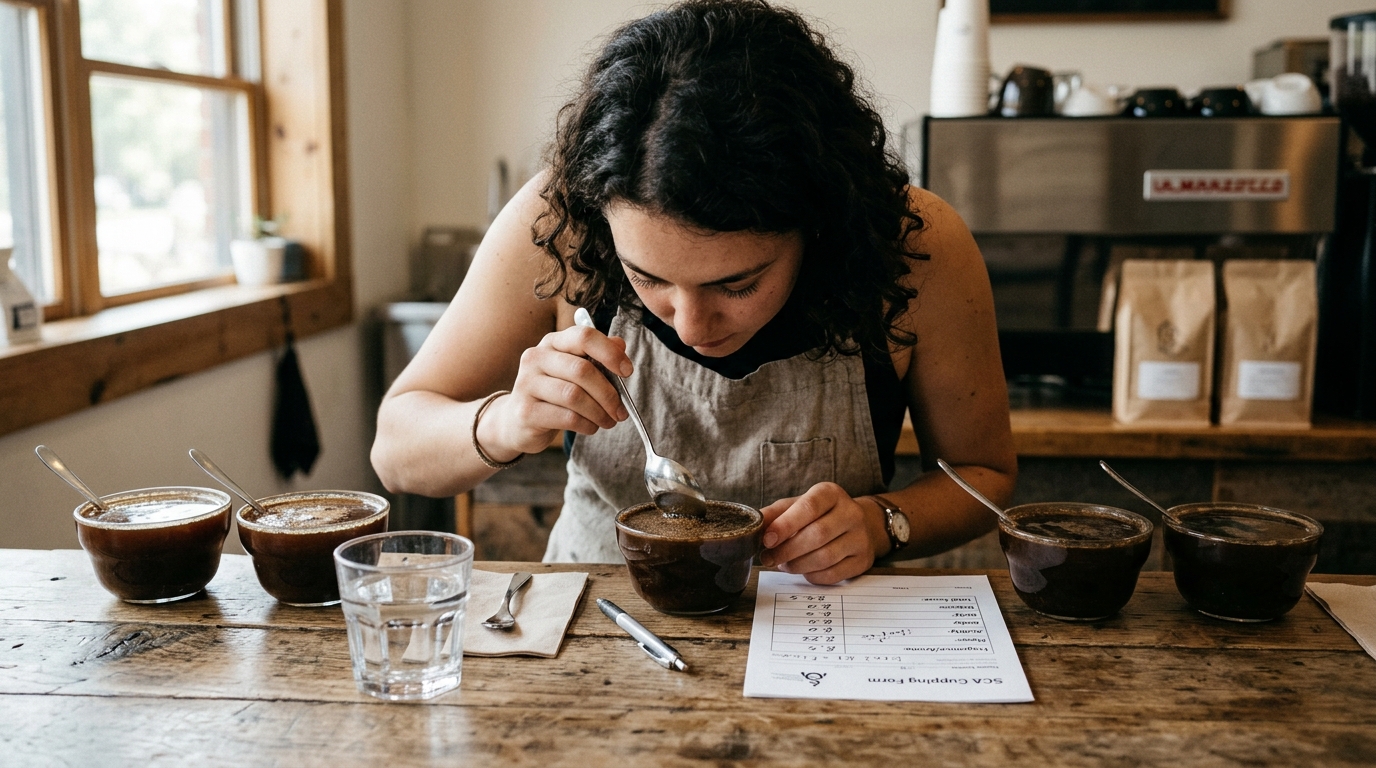
The Specialty Coffee Association's cupping protocol scores a coffee on ten attributes: fragrance and aroma, flavor, aftertaste, acidity, body, balance, uniformity, clean cup, sweetness, and overall. Each attribute is scored on a 6-point scale anchored at 6 (good), 7 (very good), 8 (excellent), and 9 (outstanding), with decimal increments allowed between whole numbers. The ten scores are summed to produce a final number out of 100, and any coffee that scores 80 or above qualifies as "specialty grade."
The physical setup matters enormously here. Cupping uses a standardized 8.25 grams of coarsely ground coffee per 150ml of water, steeped for four minutes at 200 degrees Fahrenheit (93.3 Celsius), then broken and evaluated as the cup cools from around 160F (71C) down to room temperature. This is a coarse immersion brew with no pressure, no crema, no soluble extraction pushed above roughly 22 percent. The protocol is designed for consistency and repeatability across labs, not for predicting how a coffee will behave under 9 bars of pressure through a 20-gram puck in 28 seconds.

What the Score Is Actually Measuring
A high SCA score tells you that a coffee, when brewed under controlled cupping conditions, expressed clean, complex, well-balanced flavors with no defects. It tells you about the raw material, about how well the cherry was processed, how cleanly it was dried, and whether the roaster preserved those inherent characteristics without introducing excessive carbon or baking the sugars flat. What it does not tell you is how those characteristics will translate under espresso extraction, which is a fundamentally different chemical process.
Espresso extracts a much wider range of compounds than cupping does. The combination of pressure, fine grind size, heat, and relatively low water volume pushes extraction into territory where delicate floral and fruit-forward notes can become sharp or sour, where a bright acidity that reads as "lively" in a cupped Kenya can turn into something thin and abrasive in the cup. Conversely, a well-balanced natural Ethiopian that scores an 84 on the cupping table might produce a thick, syrupy, complex espresso because its body and sweetness translate beautifully under pressure. The score doesn't tell you which direction things will go.
The Roast Level Problem
There's an additional complication that rarely gets discussed in roaster marketing: the SCA scoring system, as practiced by most Q Graders and specialty buyers, skews heavily toward lighter roasts. This isn't a conspiracy. It reflects a real progression in the specialty industry's understanding that light roasts preserve more of the terroir and varietal character of a coffee. A naturals-processed light roast from a high-altitude Ethiopian farm has more chemically interesting things to say than a dark-roasted blend, and the cupping protocol rewards those characteristics.
But lighter roasts are genuinely harder to work with in espresso. Their denser, less porous cell structure requires finer grinding and longer pre-infusion to extract evenly. They tend to produce sharper acidity at conventional espresso temperatures around 198-202F (92-94C), often requiring you to brew hotter, at 203-206F (95-96C), to coax sweetness forward. A bag of 91-point light roast Geisha might be an extraordinary cupping experience and a frustrating espresso experience if you haven't calibrated your technique to match it. Meanwhile, a 400-gram bag of a 84-point medium-dark blend designed for espresso might pull beautifully at 200F (93C) with no drama at all, because the roaster optimized it for that brew method.
When the Score Does Matter
This isn't an argument that SCA scores are meaningless. For identifying baseline quality and defect-free processing, the threshold matters. Coffees below 80 points have measurable defects, whether that's ferment, phenolic off-notes, or woody flatness from over-drying. Spending money on sub-80 coffee for espresso is a bad idea regardless of the price, because defects amplify under pressure extraction the same way they amplify in any intense brew method. You're not going to brew your way around a fermented processing note.
The score also gives you a rough signal about complexity. An 85-point coffee and a 92-point coffee, cupped back to back, will usually show real differences in layering and clarity, even if neither score predicts espresso behavior perfectly. If you're buying from a roaster you don't know, the cupping score is a reasonable proxy for "did someone with trained palate verify this coffee is clean and interesting." That's worth something.
What to Look for Instead
When choosing coffee for espresso, the score should be one data point among several, and probably not the most important one. More useful signals include:
- Whether the roaster has explicitly dialed it in for espresso, or at least noted espresso in their brew recommendations
- Process and origin: washed Central Americans and Colombians tend to be more forgiving in espresso extraction than high-acidity washed Kenyans or fruity Ethiopians, though those can shine with the right technique
- Roast date: fresh coffee, within 7-21 days of roast depending on the style, extracts more predictably than coffee that's been sitting
- Roast level transparency: a roaster who tells you the development time ratio or the drop temperature is giving you more actionable information than a cupping score
If a roaster lists cupping score prominently but buries or omits the roast date, that's actually a useful piece of information about their priorities.
Putting It Into Practice
The practical takeaway is this: don't pay a premium for a high SCA score if that score is the only thing distinguishing the coffee. A well-sourced, freshly roasted 84-point coffee dialed in by someone who understands espresso extraction will outperform a poorly dialed 92-point lot every single time. The score describes the coffee's ceiling under ideal cupping conditions. Your grinder, your machine, your water, your technique, and your ability to read and adjust your extraction are what determine whether you reach anywhere near that ceiling.
If you want a systematic way to track how different coffees are actually performing in your espresso setup rather than on paper, logging your shots over time tells you more than any marketing number. That's part of what I built grindset.cafe to help with: keeping a record of what you actually tasted and what variables you changed, so patterns emerge over time. A score on a bag is a starting point for conversation. The cup you pull tomorrow morning is the only score that counts.