Pressurized vs Non-Pressurized Portafilter Baskets: What They Are, How They Differ, and Which One You Actually Need
By the Grindset team · April 13, 2026 · 7 min read
The Basket Is Not Just a Container
Most people buying their first espresso machine spend weeks agonizing over the machine itself, then accept whatever portafilter basket came in the box without a second thought. That basket, though, has more influence over what ends up in your cup than almost any other single component. Understanding the difference between a pressurized basket and a non-pressurized basket is not a minor technical footnote. It changes how you grind, how you tamp, what coffees you can use successfully, and what kind of espresso you can realistically produce.
The confusion is understandable. Both baskets sit in the same portafilter, both look roughly similar from the outside, and manufacturers rarely explain the distinction in plain terms. So let's work through exactly what each design does, how the physics differ, and when one is genuinely the right tool for the situation.
How a Non-Pressurized Basket Works
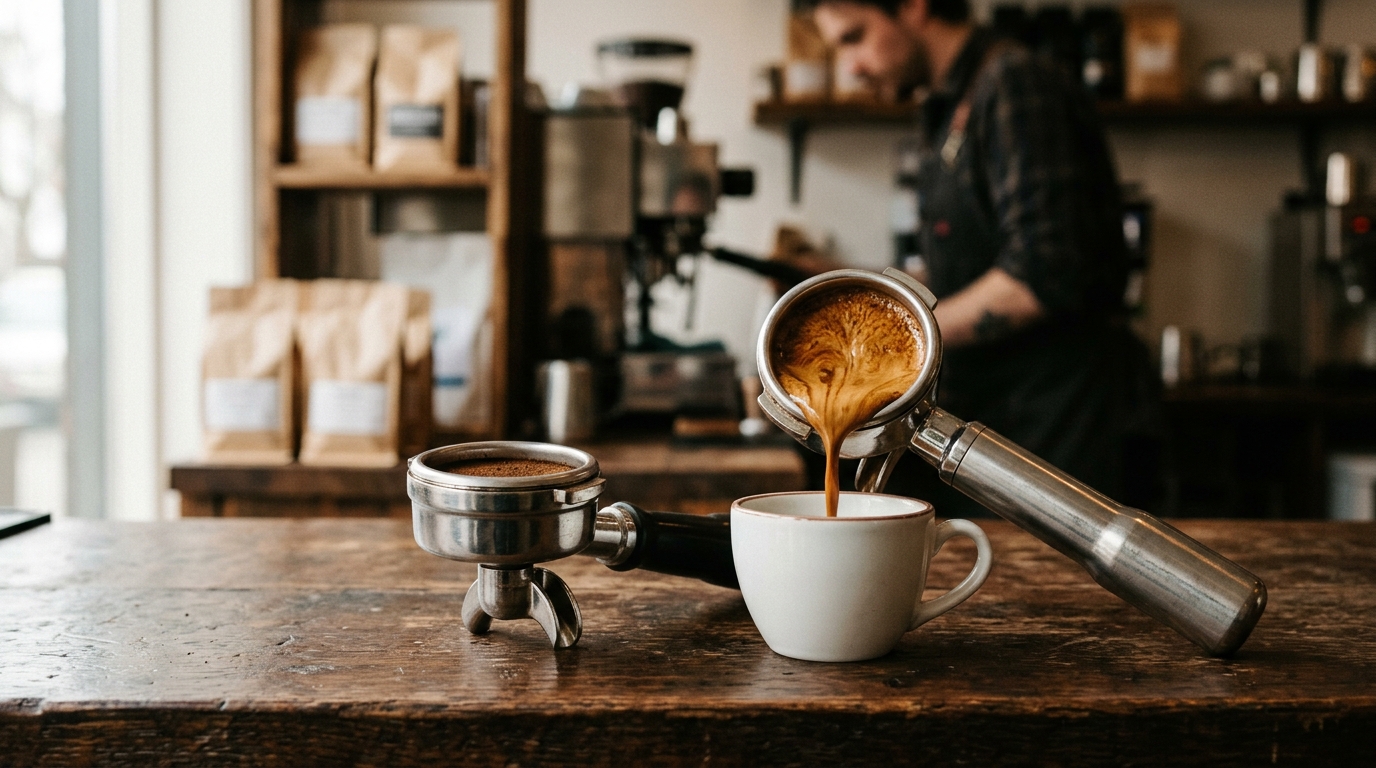
A non-pressurized basket, sometimes called a single-wall basket, is the professional standard. The bottom of the basket is perforated with dozens of small holes, typically 0.3mm to 0.5mm in diameter. When you pack ground coffee into it and force water through at 9 bars of pressure, the resistance to that flow comes entirely from the coffee bed itself. The grind size, the dose, the distribution, and the tamp all work together to create a flow restriction that ideally slows 9 bars of incoming pressure down to a 25 to 35 second extraction at roughly 1 to 2ml per second.
This is why grind quality matters so much with single-wall baskets. The coffee is doing all the work. If your grind is too coarse, water blasts through in 15 seconds and you get a thin, sour, underextracted shot. If it's too fine, flow stalls and you get a bitter, overextracted, or even choked machine. The margin for error is real. But within that margin, you have complete control over the extraction. You can taste the difference between a 27-second pull and a 32-second pull on the same coffee. That feedback loop is how you learn to dial in a coffee properly.
Non-pressurized baskets also allow for crema to form naturally. Crema is an emulsion of carbon dioxide gas and coffee oils, and it forms when the pressure differential across the coffee bed is high enough to hold CO2 in suspension as the liquid passes through. With fresh coffee and a properly dialed grind, a single-wall basket produces a dense, reddish-brown crema that is a reliable indicator of extraction quality.
How a Pressurized Basket Works
A pressurized basket, also called a double-wall basket or dual-wall basket, takes a fundamentally different approach. The basket has two walls: the inner wall holds the coffee and has relatively large holes, and the outer wall has a single small hole or a very restricted number of openings. The coffee bed itself creates little to no meaningful flow resistance, because the actual pressure restriction is built into the basket's construction.
What this means in practice is that the machine builds pressure regardless of what's happening in the coffee puck. Even pre-ground supermarket coffee, tamped loosely, will produce what looks like a reasonable shot with a thin layer of crema on top. The crema in this case is mostly a product of the pressurized release through the restricted orifice rather than a true emulsification formed by the extraction. It's visually similar but tastes different and dissipates much faster, and it doesn't carry the same flavor information that natural crema does.
The pressurized basket was engineered to solve a practical problem: entry-level machines with lower-powered pumps and users who don't own a quality burr grinder. By building the pressure restriction into the basket, the manufacturer makes the system forgiving. A mediocre grind won't choke the machine or produce a watery pour. The result is more consistent in the hands of a new user with grocery store pre-ground coffee.
The Real Tradeoffs
The benefit of a pressurized basket is exactly its limitation. Because the basket provides artificial resistance, you lose the feedback loop. A 15-second pour and a 35-second pour can look similar in the cup because the basket is masking the difference. You cannot taste the grind adjustment you just made because the basket has neutralized it. This makes pressurized baskets poor tools for learning espresso technique. You are practicing, but the results don't reflect your inputs accurately.
With a non-pressurized basket, every variable matters and every change is legible. This demands more from your equipment. You need a grinder capable of producing a consistent grind in the 200 to 400 micron range with low fines variance, which generally means a quality burr grinder, either hand or electric, priced at $100 or more at minimum. Pre-ground coffee from a bag is almost never ground fine enough or consistently enough to work well in a single-wall basket. Freshness matters too, because degassed coffee produces less resistance and shifts your extraction parameters.
Temperature stability and pump pressure also become relevant with single-wall baskets in a way they aren't with pressurized ones. A machine that swings between 190°F (88°C) and 205°F (96°C) mid-shot will produce inconsistent results regardless of how well you've dialed in the grind. At 93°C, you're in an extraction window that works well for medium to light roasts. At 88°C, you're going to struggle to fully extract the same coffee. The non-pressurized basket makes these machine limitations visible because nothing is buffering them.
Which One Actually Belongs in Your Setup
If you own a quality burr grinder, buy fresh whole beans, and want to improve your understanding of extraction, use a non-pressurized basket. Full stop. The single-wall basket will reward your investment in equipment and attention with shots that pressurized baskets simply cannot produce. You will also be able to use data from your extractions meaningfully, whether you're tracking yield ratios like 1:2 in 28 seconds or adjusting your grind by half a notch at a time.
If you are working with pre-ground coffee, a blade grinder, or a lower-end entry-level machine with an inconsistent pump, a pressurized basket is not a compromise to be embarrassed about. It is the correct tool for that context. Forcing a non-pressurized basket onto a setup that can't support it produces bad espresso and teaches you nothing useful. The pressurized basket will give you something drinkable while you build toward better equipment.
A practical path many people follow is starting with pressurized baskets, investing in a proper grinder as the next upgrade, then switching to single-wall baskets once the grinder can support it. The machine often matters less than the grinder in this equation. A modest machine with a good grinder and a single-wall basket will outperform an expensive machine paired with blade-ground coffee in a double-wall basket.
Identifying What You Have and What to Buy
To check your existing basket, look at the underside. A pressurized basket will have a second visible layer with one or very few holes, often with a small rubber seal or pin mechanism in the center hole. A non-pressurized basket will show a clean grid of evenly spaced perforations with no secondary wall. If you're buying a replacement, brands like IMS, VST, and Pullman make precision single-wall baskets with tight manufacturing tolerances that improve shot consistency noticeably over stock OEM baskets. VST baskets in particular have published research behind their hole geometry and are worth the $30 to $50 investment once you're extracting seriously.
When you're tracking your shots, knowing your basket type is a prerequisite for interpreting your data correctly. I built grindset.cafe partly around the idea that extraction logging is only useful when you understand what each variable in the system is actually doing. The basket is one of those foundational variables. Get it right, and everything else you measure starts to make sense.