How Water Temperature Affects Espresso Extraction: The Case for Brewing Between 195°F and 205°F
By the Grindset team · March 18, 2026 · 6 min read
Why Temperature Is One of the Most Consequential Variables in Espresso
Every espresso shot is a controlled extraction event. You are forcing hot water through compacted coffee grounds under pressure, dissolving hundreds of soluble compounds in a window of roughly 25 to 35 seconds. Within that window, water temperature determines which compounds dissolve, how quickly they dissolve, and in what proportion they end up in your cup. Get it right and you have balance, sweetness, and clarity. Get it wrong and the shot tastes flat, harsh, or sour in ways that grind adjustments and dose changes simply cannot fix.

The conventional guidance of 195°F to 205°F (90.5°C to 96°C) is not arbitrary. It reflects decades of practical experience and a reasonable understanding of how heat drives dissolution in a coffee matrix. But within that 10-degree range, there is a lot of room for meaningful variation, and understanding why that range exists in the first place gives you the tools to make deliberate decisions rather than just follow a rule.
What Heat Actually Does to Coffee Compounds
Coffee contains thousands of soluble compounds, but for extraction purposes the ones that matter most are organic acids, sugars and Maillard products, bitter alkaloids and phenolics, and melanoidins. These compounds do not dissolve at the same rate or respond to temperature the same way. Organic acids, particularly the brighter ones like malic and citric acid, dissolve readily even at lower temperatures. Sugars and the complex browning compounds from the roasting process require more heat to go into solution efficiently. Bitter compounds, including certain chlorogenic acid degradation products, also extract more aggressively as temperature rises.
This is the core tension in temperature selection: increasing heat pulls more sweetness and body from the coffee, but it also extracts more bitterness. Decreasing heat preserves acidity and clarity, but risks under-extracting the compounds that give a shot its weight and roundness. Below roughly 185°F (85°C), extraction becomes so inefficient that even a very fine grind cannot compensate. Above about 205°F (96°C), you accelerate the extraction of harsh, astringent compounds faster than you gain sweetness, and at 212°F (100°C) you are also affecting dissolved CO2 behavior and risking scorching of volatile aromatics near the bed surface.
The Lower End of the Range: 195°F to 198°F
Brewing at the cooler end of the recommended range, between 195°F and 198°F (90.5°C and 92.2°C), tends to produce shots with more pronounced acidity and a lighter, more tea-like body. This makes sense given that you are extracting the more temperature-sensitive acids efficiently while leaving some of the heavier Maillard and caramelization products behind. For lighter-roasted coffees with high inherent acidity and delicate floral or fruit character, this range can be exactly right. The reduced extraction efficiency at lower temperatures means you often need to compensate with a finer grind or longer pre-infusion to hit your target yield without the shot tasting thin.
Some baristas also use the lower end of this range deliberately when working with very dense, high-grown beans that have a lot of bright acidity baked in. Dropping to 195°F or 196°F pulls back on the extraction of those acids just enough to keep the shot from reading as harsh while still getting a reasonable amount of sweetness into the cup. It is a balancing act, and one that requires you to know your coffee's flavor profile well before deciding to cool the brew temperature down.
The Upper End of the Range: 200°F to 205°F
At 200°F to 205°F (93.3°C to 96°C), you are creating conditions that favor more complete dissolution of the heavier, sweeter compounds. Medium and dark roasted coffees respond particularly well here because the roasting process has already converted much of the raw vegetative and acidic character into the caramelized and Maillard products that require heat to extract properly. A shot pulled at 203°F (95°C) from a well-developed medium roast will typically show more body, more sweetness, and a longer finish than the same coffee pulled at 196°F (91.1°C), often at the cost of slightly more perceived bitterness if the extraction is pushed too far.
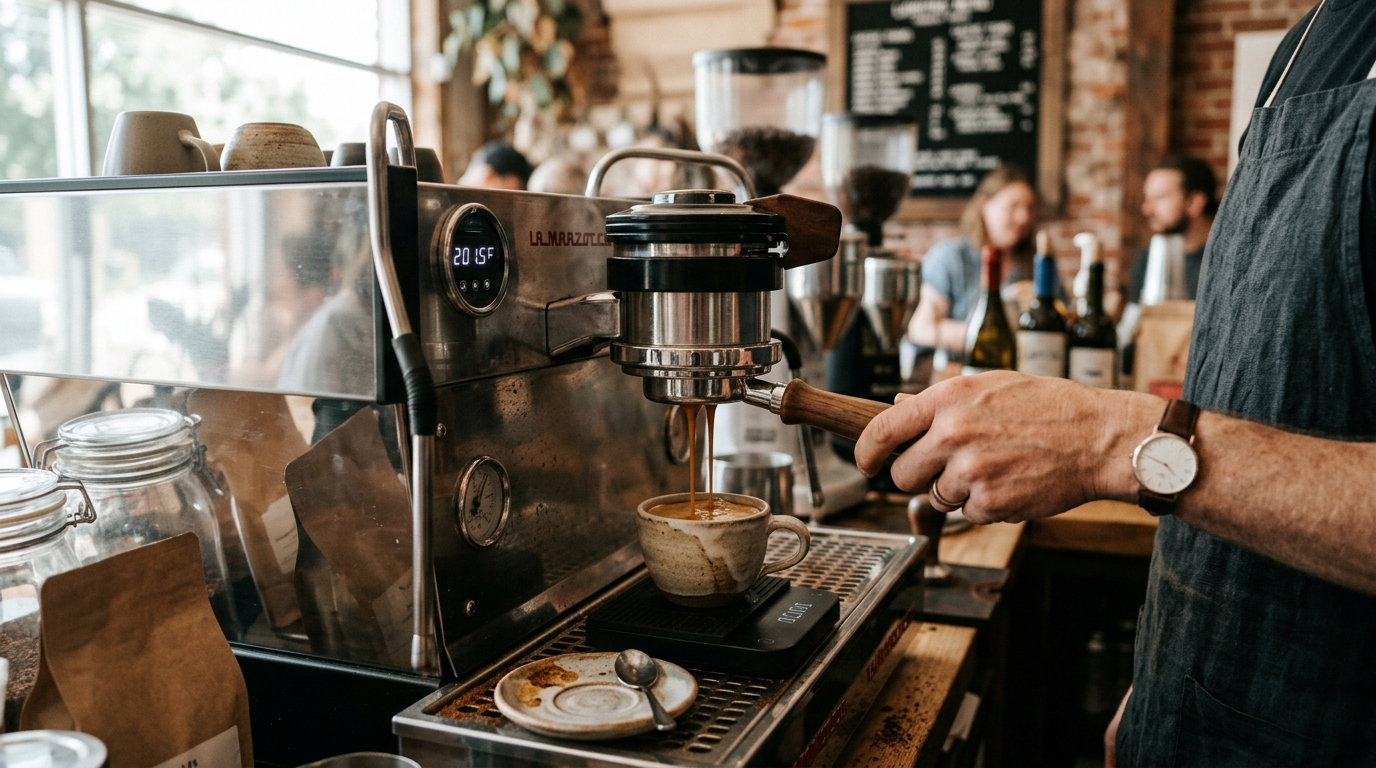
There is also a practical argument for the higher end of this range when you are working with machines that have imprecise or inconsistent temperature control. A boiler or thermoblock that is set to 200°F may be delivering water that fluctuates between 197°F and 202°F depending on idle time, shot frequency, and ambient conditions. Targeting 203°F or 204°F gives you a buffer so that temperature dips during a shot do not crater extraction efficiency mid-pull. On machines with genuine PID stability, this concern is less acute, but it is worth keeping in mind if your equipment is older or less precise.
Why Roast Level Should Drive Your Temperature Decision
The single most reliable predictor of where to start your temperature dialing is roast level. Darker roasts have undergone more structural breakdown during roasting. Cell walls are more porous, CO2 degasses more readily, and the soluble compounds are chemically simpler and more available. These coffees extract quickly and easily, which means higher temperatures amplify the risk of bitterness and harsh phenolic extraction. Starting around 197°F to 200°F (91.7°C to 93.3°C) for a dark roast is sensible.
Lighter roasts are denser, less porous, and retain more complex, heat-resistant compounds that require more energy to dissolve. Starting at 202°F to 205°F (94.4°C to 96°C) for a light roast is a reasonable baseline, and some roasters even push slightly above that range to get adequate sweetness out of very light, acidic coffees. The point is that temperature is not a universal setting. It is a variable that should be calibrated to your specific coffee the same way grind size and dose are.
Practical Takeaways for Dialing In Temperature
- Start at 200°F (93.3°C) as a neutral baseline for any new coffee and adjust from there based on what you taste.
- If the shot tastes sour or thin with good extraction time, try increasing temperature by 2°F to 3°F before changing the grind.
- If the shot tastes harsh or bitter with an otherwise acceptable yield and time, try dropping temperature by 2°F to 3°F before coarsening the grind.
- Change one variable at a time. Temperature and grind interact, and changing both simultaneously makes it impossible to identify which adjustment made the difference.
- Give the machine time to stabilize after changing the set point. Most machines need at least one or two full flush cycles before the brew water reliably reaches the new target temperature.
Temperature logging across multiple shots is one of the more underrated practices in home espresso. It is easy to assume your machine is hitting target when it is actually drifting a few degrees over a session. Tracking this data over time, which is something grindset.cafe is built to support, gives you the context to know whether a bad shot was a variable problem or an equipment problem.
The Bottom Line
Water temperature between 195°F and 205°F is not just a safe middle ground. It is the range where espresso extraction is thermodynamically efficient, chemically productive, and controllable. Outside that range, you are fighting the chemistry rather than working with it. Within that range, moving deliberately based on roast level and taste feedback puts you in a position to pull consistently excellent shots rather than hoping for a good one. Temperature is not a set-it-and-forget-it variable. It deserves the same attention you give to your grind and your ratio.