Why Your Espresso Tastes Different Every Morning: The Variables You Can Actually Control
By the Grindset team · March 18, 2026 · 7 min read
The Illusion of a Repeatable Recipe
You pull what feels like the exact same shot every morning. Same beans, same grinder setting, same dose, same machine. Yet one day it's balanced and sweet, and the next it's harsh and thin. This inconsistency frustrates even experienced home baristas, and the reason it happens isn't random bad luck. Espresso is one of the most variable brewing methods in existence, because it stacks more interacting parameters on top of each other than any other preparation style. Understanding which variables drift overnight, and which ones you can actually control, is the difference between chasing your tail and pulling consistently good shots.
The core issue is that espresso operates under conditions where small changes have outsized effects. You're forcing water at 8 to 9 bars of pressure through roughly 18 to 20 grams of compressed coffee in 25 to 30 seconds. At that pressure and that contact time, a 0.1g difference in dose, a half-degree temperature shift, or even a change in ambient humidity can meaningfully alter the flavor in the cup. These aren't theoretical sensitivities. They show up as real, perceptible differences in sweetness, bitterness, and body.
Your Grinder Changes Overnight
The single biggest source of morning-to-morning variation for most people is the grinder, specifically the fact that metal burrs thermally contract when they cool down overnight. When burrs are cold, they sit fractionally closer together than they do after 20 minutes of grinding under load. This means your first shot of the day is being ground finer than your second, even though you haven't touched the adjustment ring. The effect is small in absolute terms, maybe a few microns, but at espresso grind sizes, a few microns changes your particle size distribution enough to slow flow rate and shift extraction.
The practical fix is to run a purge dose through the grinder before you pull your first shot. Grinding 2 to 5 grams of coffee without saving it lets the burrs warm up slightly and clears any stale grounds sitting in the chute from the day before. Stale grounds in the chute are worth addressing separately: old coffee that has been sitting exposed to air overnight will taste flat and papery, and if it mixes with your fresh dose, it degrades the cup noticeably. A purge eliminates both problems at once.
Ambient Humidity Does More Than You Think
Coffee grounds are hygroscopic, meaning they absorb moisture from the surrounding air. On a humid morning, your ground coffee absorbs enough atmospheric water to swell the particles slightly and increase surface tackiness. This causes finer particles to clump together more aggressively, which produces uneven puck density, channeling, and an erratic flow rate. On a dry winter morning, the same grind setting and dose will flow faster and extract differently because the grounds aren't sticking together the same way.
You can't control the weather, but you can respond to it. Keeping a log of your extraction times alongside weather conditions over a few weeks reveals a clear pattern for most setups. If your shots are running noticeably slow and you haven't changed anything, check the humidity. A dial or digital hygrometer costs almost nothing and tells you immediately whether the air is the culprit. Raising your grind setting by a half step on high-humidity days is often all it takes to get back on target.
Stale Coffee and the CO2 Problem
Degassing is the process by which freshly roasted coffee releases carbon dioxide that was trapped in the bean structure during roasting. In the days immediately after roast, beans are still actively venting CO2, and when you grind and dose that coffee, the gas escapes rapidly during extraction. This creates resistance in the puck that isn't purely about grind size, and it also forms bubbles that interfere with water contact and extraction uniformity. Shots pulled from coffee roasted within the last 3 to 5 days often taste sour, gassy, and hollow for this reason.
As coffee ages past the two-week mark, degassing slows and eventually the beans start losing volatile aromatic compounds to oxidation instead. The sweet spot for most espresso is roughly 7 to 21 days post-roast, though this varies by roast level. Lighter roasts tend to need more rest and hold their quality longer. Darker roasts degas faster and stale faster. If your bag has been open for more than three weeks and sitting at room temperature, that's likely contributing to flat, lifeless shots regardless of how well you've dialed in everything else.
Machine Temperature Is Not As Stable As the Display Suggests
Single boiler machines are the most obvious offenders here, but even higher-end machines with PID controllers have thermal gradients inside the group head that shift depending on how long the machine has been idle. The displayed boiler temperature is not the brew water temperature at the puck. Water picks up or loses heat as it travels through the group head, and if the group head itself is cold because the machine sat idle for 45 minutes, the actual brew temperature at the coffee bed can be 5 to 10 degrees Fahrenheit lower than your setpoint. At 90°C (194°F) versus 95°C (203°F), you're pulling a fundamentally different extraction.
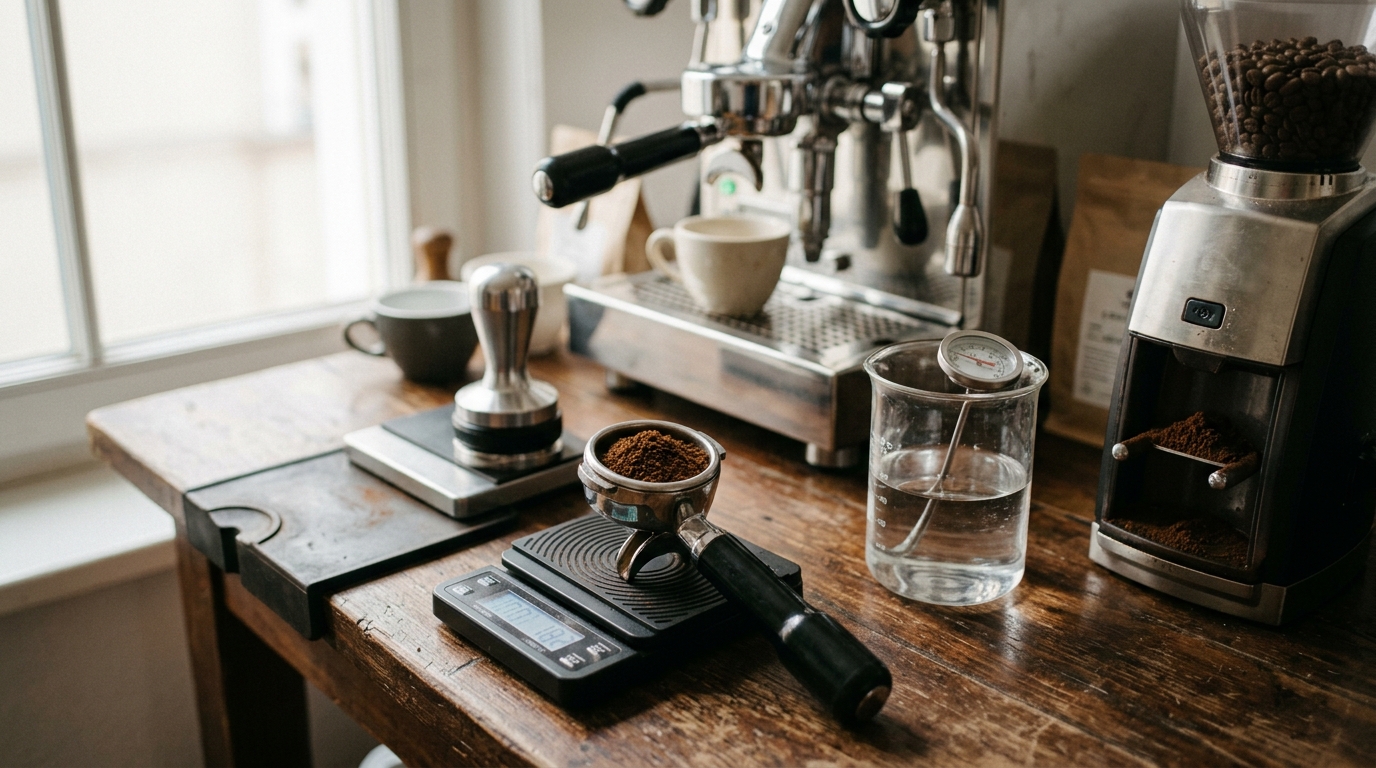
The solution is a consistent warm-up and flush routine. Flushing 30 to 50 grams of water through the group head immediately before locking in your portafilter brings the metal mass of the group up to a stable temperature. How long your machine needs to warm up before it reaches thermal stability is something you should test once and then make a fixed habit. Most machines with a single boiler need at least 20 minutes; some need 30. Running a shot at the same point in the warm-up cycle every morning is one of the highest-value consistency habits you can build.
Dose and Distribution: Small Errors Compound
A 0.5 gram difference in dose might seem negligible, but consider the math: if your target is 18 grams in and 36 grams out in 28 seconds, dropping to 17.5 grams while holding everything else constant means your ratio has shifted. The puck is slightly less dense, water finds the path of least resistance faster, and your extraction time shortens. This is why weighing every dose matters, and why a consistent distribution technique matters just as much. An unevenly distributed puck has areas of different density, which means water channels through the loose sections while under-extracting the dense ones. The result is a shot that tastes simultaneously sour and bitter, because you're getting both under- and over-extracted coffee in the same cup.
Use a scale every time. A distribution tool or careful tapping and leveling before tamping is worth the extra 15 seconds. Tamp with consistent pressure, roughly 15 to 20 kg of downward force, and make sure you're tamping level. These steps don't need to be ceremonial, they just need to be consistent.
Building a System That Fights Drift
The goal isn't to eliminate all variability, which is impossible. The goal is to reduce the number of things that can change without your knowledge so that when a shot does taste different, you have a short list of suspects to check. A morning routine that includes a grinder purge, a consistent machine warm-up time, a weighed dose, and a quick check of your extraction time gives you a repeatable baseline to work from. Over time, logging your results in something like grindset.cafe helps you spot patterns across days and weeks that aren't visible shot-to-shot.
Espresso rewards the kind of attention where you notice small changes before they compound into big ones. The variables covered here, grinder temperature, ambient humidity, bean age, machine thermal stability, and dose consistency, account for the vast majority of unexplained shot-to-shot variation. Get those under control, and your morning cup stops being a mystery.