
How the Origin of Your Coffee Beans Shapes the Taste of Your Espresso
By the Grindset team · July 13, 2026 · 6 min read
Why Origin Matters More in Espresso Than Any Other Brew Method
Espresso is a concentrating process. You are pushing roughly 9 bars of pressure through 18 to 20 grams of coffee in about 25 to 30 seconds, producing somewhere between 36 and 40 grams of liquid. That concentration ratio, typically 1:2 by weight, means that every flavor compound present in the bean ends up magnified in the cup. A subtle fruity acidity that reads as pleasant in a pour-over can become sharp and almost aggressive in espresso. A mild earthiness can turn into something that dominates the entire shot. Because of this, the growing origin of your beans is not just background information. It is one of the most direct predictors of what your espresso will actually taste like.
The flavor characteristics we associate with specific origins are not arbitrary or romantic marketing language. They are the result of measurable differences in altitude, soil mineral composition, average temperature, rainfall patterns, and the genetic varieties of Coffea arabica or Coffea canephora being grown. These environmental factors influence the density of the bean, the sugar and acid development during fruit maturation, and the concentration of chlorogenic acids and other precursors that drive flavor during roasting. Understanding these mechanisms gives you a much better framework for choosing beans and dialing in your shots.
Ethiopian Coffees: Floral, Fruity, and Structurally Demanding
Ethiopia is the genetic origin of arabica coffee, and its coffees reflect an extraordinary degree of variety. Beans from the Yirgacheffe region tend toward intense floral and citrus characteristics, driven largely by high concentrations of organic acids, particularly citric and malic acid, developed during slow maturation at elevations above 1800 meters. Heirloom varieties grown in these conditions produce small, dense beans with complex aromatic profiles that translate into espresso with a lot of brightness and a thin to medium body.
In espresso, this creates a specific technical challenge. The high acidity and lower natural sweetness of many Ethiopian naturals and washed coffees mean that under-extraction reads as sour and thin almost immediately, while over-extraction turns that brightness into a harsh, dry bitterness. The extraction window is narrower than with Latin American coffees. You generally want to pull these shots slightly shorter, around a 1:1.75 to 1:2 ratio at around 200 to 201 degrees Fahrenheit (93 to 94 degrees Celsius), and pay close attention to your grind distribution to avoid channeling through the lighter, more porous sections of the puck.
Colombian and Central American Coffees: The Balanced Middle Ground
Colombia's major growing regions, Huila, Nariño, and Antioquia, produce coffees that have become a baseline reference point for balanced espresso. Grown at elevations between 1500 and 2000 meters with consistent rainfall and volcanic soil, Colombian washed coffees tend to have clean, well-structured acidity, medium body, and caramel to stone fruit sweetness. The phosphoric acid content in some Huila coffees contributes to a distinctly clean, almost effervescent quality that holds up well under espresso's concentration.
Central American origins, particularly Guatemala's Antigua and Huehuetenango regions, share some of this balance but often add a heavier body and a cocoa or brown sugar quality that makes them especially forgiving to work with. Guatemalan coffees frequently have a slightly lower acidity relative to their sweetness, which means the extraction window is wider and small errors in grind size or temperature produce less dramatic results. For someone building their first espresso-focused workflow, a well-sourced Guatemalan or Colombian washed coffee is often the most instructive choice because the feedback from the cup is clearer and more proportional to the variables you changed.
Brazilian and Indonesian Coffees: Body, Earthiness, and Blend Anchors
Brazil is responsible for a significant share of the world's espresso blends, and for good reason. Brazilian coffees, particularly those from Minas Gerais and Sul de Minas, are typically grown at lower altitudes between 900 and 1200 meters. Lower altitude means slower sugar development and a softer cellular structure, which produces a less dense bean with lower acidity and a pronounced nutty, chocolatey, and sometimes biscuit-like character. The natural and pulped natural processing methods common in Brazil amplify body and sweetness by allowing the coffee cherry's sugars to migrate into the bean during drying.
In espresso, Brazilian coffees produce a heavy, syrupy mouthfeel that many drinkers associate with traditional Italian-style espresso. They are also less volatile than high-grown African coffees, meaning they extract more evenly and are more tolerant of higher brewing temperatures, around 201 to 203 degrees Fahrenheit (94 to 95 degrees Celsius). Indonesian coffees, particularly wet-hulled Sumatrans, take this even further. The wet-hulling process, where parchment is removed while the bean still has high moisture content, creates a distinct earthy, herbal, and sometimes musty flavor profile with very low acidity and an almost syrupy texture. These coffees are polarizing as single origins in espresso but serve a specific role in blends where you want to add weight and depth without adding brightness.
How Blending Across Origins Shapes Espresso Strategy
Most commercial espresso blends are constructed by combining beans from different origins to hit a specific flavor target across the entire cup, from the front-palate acidity to the lingering finish. A classic approach is to use a Brazilian natural or pulped natural as the base, contributing body and sweetness, and layer in a washed Ethiopian or Kenyan component for brightness and aromatic complexity. The ratio matters enormously. At 20 percent Ethiopian in a blend, you get a hint of fruit. At 40 percent, the floral and citrus notes start leading the cup.
The practical implication is that when you buy a blend, the origin composition is one of the most useful pieces of information on the bag, more useful than roast dates alone. A blend anchored in Brazil and Central America will behave differently on your machine than one built around African washed coffees, and your starting parameters for extraction temperature, shot ratio, and grind size should shift accordingly. Single origins require you to understand the specific bean you are working with rather than relying on blending to smooth out the edges.
Putting This Into Practice
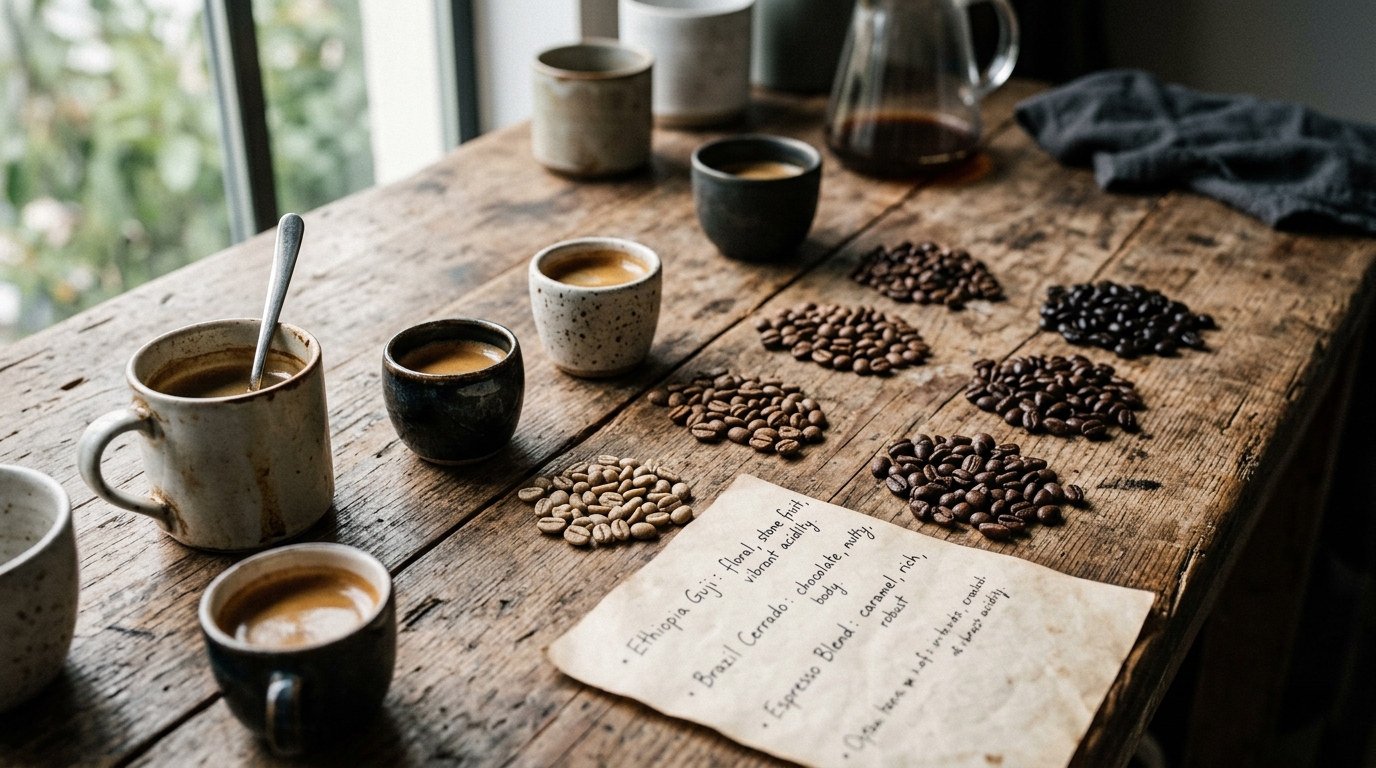
The way to build this knowledge is through deliberate comparison rather than trying to memorize regional generalizations. Pull the same shot weight and ratio across an Ethiopian natural, a Colombian washed, and a Brazilian natural. Keep your dose at 18 grams, your yield at 36 grams, and your time between 27 and 30 seconds. Adjust only temperature between sessions, starting at 200 degrees Fahrenheit (93 degrees Celsius) for all three. The differences you taste will map closely onto the origin and processing characteristics described here, and those sensory memories become your actual reference library.
Tracking these variables and tasting notes systematically makes the patterns visible much faster. I built grindset.cafe partly because I wanted a structured way to log exactly this kind of origin-to-cup comparison without losing data across sessions. The goal is to build a mental model where you can look at an origin on a bag and already have a reasonable hypothesis about how the shot will behave before you pull it. That predictive ability does not come from reading alone. It comes from pulling hundreds of shots with intention and keeping records precise enough to mean something.