How to Descale Your Espresso Machine: A Step-by-Step Guide to Removing Mineral Buildup Safely
By the Grindset team · March 23, 2026 · 6 min read
Why Scale Buildup Is a Real Problem, Not Just a Warning Light
Limescale is calcium carbonate, and it deposits inside your machine every time water is heated. The mineral content of your water determines how fast it accumulates, but even with relatively soft water, any machine used daily for a year will have meaningful buildup inside the boiler, heating element, and internal tubing. The physics of this matter: calcium carbonate precipitates out of solution as water temperature rises, and the interior surfaces of an espresso machine's boiler regularly hit 200 to 212 degrees Fahrenheit (93 to 100 degrees Celsius). Scale is essentially inevitable.

The consequences go beyond a slower heating time. A scaled boiler has reduced thermal efficiency because calcium carbonate is a poor conductor of heat compared to stainless steel or brass. Your machine has to work harder to reach target temperature, which means more wear on the heating element over time. More practically for your espresso, scale can partially restrict grouphead solenoids and internal valves, causing inconsistent pre-infusion pressure and erratic flow rates. Shots that have been pulling cleanly start losing consistency, and the cause is buried inside the machine where you can't see it.
Descaling Solution vs. Citric Acid vs. Vinegar
The chemistry of descaling comes down to using a mild acid to convert calcium carbonate into a water-soluble compound that can be flushed out. The three most common options are proprietary descaling solutions, citric acid, and white vinegar, and they are not equally good choices.
Proprietary descaling solutions, like those from Dezcal, Urnex, or your machine's manufacturer, are typically formulated with lactic acid or a blend of acids buffered to be effective at dissolving scale without being aggressive toward rubber seals and o-rings. For most home machines, this is the safest option, and the cost is minor. Follow the concentration on the package, which is usually around 1 ounce (28 grams) of powder per 34 ounces (1 liter) of water.
Citric acid is a reasonable alternative if you cannot find a commercial product. Use a 1 to 1.5 percent solution by weight, which is roughly 10 to 15 grams per liter of water. It dissolves scale well, is food-safe, and rinses clean. It is marginally less effective than some commercial blends at breaking down heavy buildup, but it works well for regular maintenance cycles.
Vinegar is the option I would discourage. Acetic acid is less effective at dissolving calcium carbonate than citric or lactic acid, the smell permeates internal components and can linger in brewed coffee for days, and some manufacturers void warranties if they detect vinegar residue during service. The small cost saving is not worth it.

Before You Start: What You Need
- Descaling solution or citric acid at the correct concentration
- Fresh, clean water for the rinsing cycles
- A large container, at least 1.5 liters, to catch the output from the grouphead and steam wand
- A soft cloth for wiping down the steam wand and exterior
- Your machine's manual, because the exact descaling mode varies significantly by manufacturer
On that last point: Breville, De'Longhi, Jura, and La Marzocco all have different procedures. Some machines have a dedicated descaling mode that controls the pump cycling automatically. Others require you to manually run partial cycles, pause, and repeat. Running the wrong procedure, for example, pushing descaling solution through a machine designed to hold it in a static soak, will reduce effectiveness. Read the manual even if you have done this before.
The Descaling Process, Step by Step
Remove and set aside your water filter if your machine uses one. Running descaling solution through a water softening cartridge destroys its ion exchange resin and renders it useless. This is a common mistake that costs people a filter replacement they did not expect.
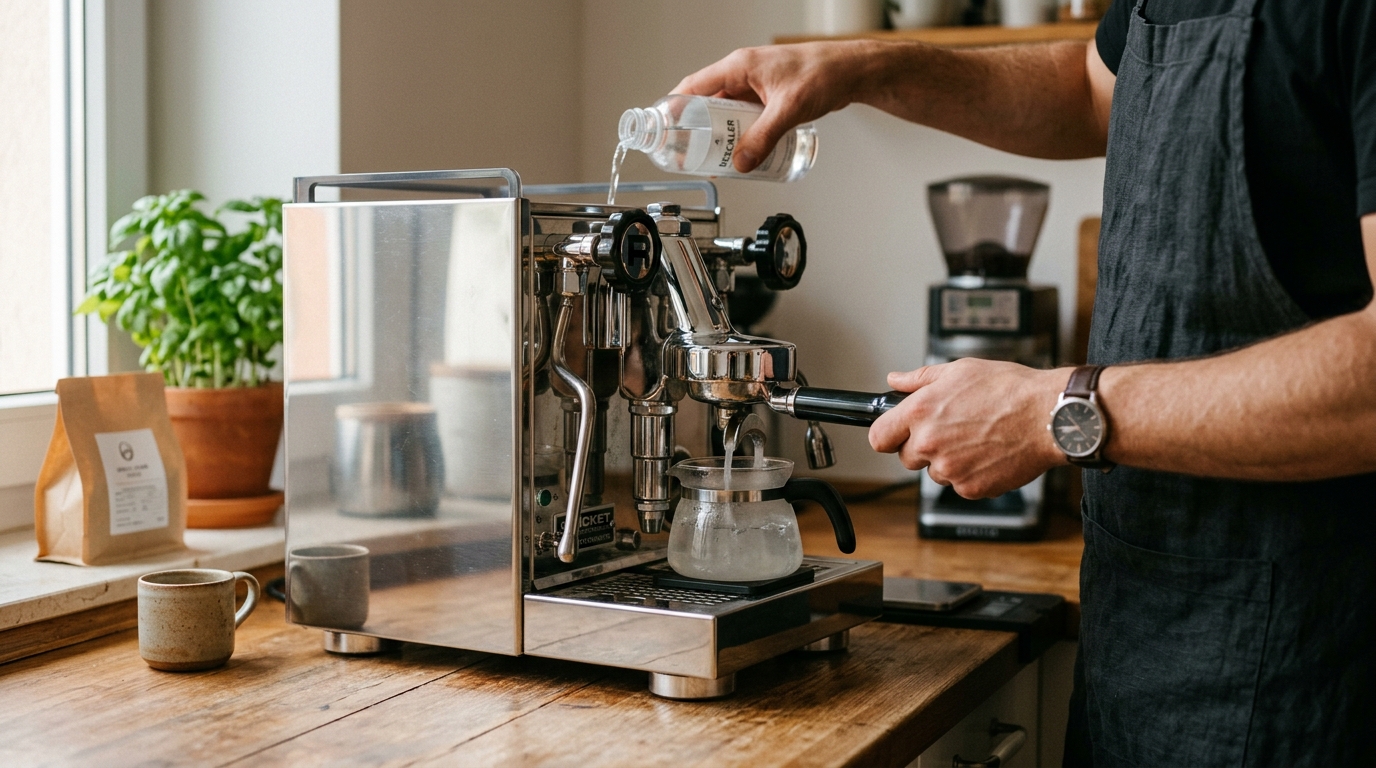
Mix your descaling solution in the reservoir according to the correct ratio and fill the tank. Place your collection container under the grouphead and under the steam wand if your machine dispenses from both during the cycle. Turn the machine to descaling mode, or begin the manual cycle as specified in your documentation.
The process involves pumping solution through the internal circuit in intervals, typically alternating between dispensing and pausing, which allows the acid time to work on the scale deposits rather than simply flushing past them. A full descaling cycle on most home machines takes 20 to 40 minutes from start to finish. Do not rush it. The pauses are doing real chemical work.
Once the descaling solution has been fully dispensed, you move into the rinse phase. Empty the collection container, fill the reservoir with fresh, clean water, and run the complete rinse cycle. Most manufacturers specify two full rinse cycles. Run both of them. Residual acid left in the system will affect the taste of every shot you pull afterward, and it can continue to act on gaskets and seals in ways you do not want.
How Often Should You Descale?
The answer depends entirely on your water hardness. Water hardness is typically measured in parts per million (ppm) of dissolved calcium and magnesium, or in grains per gallon. If your tap water is above 150 ppm, you are accumulating scale quickly, and descaling every two to three months is reasonable for a machine used once or twice daily. With water in the 50 to 100 ppm range, every four to six months is usually sufficient. Below 50 ppm, you may get away with twice a year.
Many machines include a hardness test strip in the box for exactly this reason. If you no longer have yours, inexpensive strips are available from aquarium supply stores or homebrew shops. Knowing your actual water hardness is more reliable than following a generic time-based recommendation.
If your machine's descaling indicator light or alert comes on before your scheduled interval, take it seriously. These sensors are not perfectly accurate, but they are calibrated conservatively, meaning the alert typically triggers before damage occurs, not after.
After Descaling: Pull a Sacrifice Shot
Even after thorough rinsing, pulling a shot immediately after descaling is not something I would recommend serving to anyone. Run a full shot weight of water through the grouphead into a cup, maybe 40 to 50 grams, and discard it. This is sometimes called a "sacrifice shot" and it serves as a final flush of anything that lingered through the rinse cycles. After that, your next proper shot should taste like it should: clean, without any acidity or off-notes attributable to the descaling process.
Keeping track of descaling history alongside your grind adjustments and shot logs gives you a clearer picture of your machine's maintenance state over time. At grindset.cafe, the shot logging workflow includes a space for maintenance notes precisely for this reason, because a well-kept machine and good extraction data belong together. Scale is a slow, invisible problem, and the best way to manage it is to treat descaling as a routine part of your process rather than an emergency intervention.