The Best Water Filters for Espresso Machines: Protect Your Investment and Improve Your Shot Quality
By the Grindset team · March 27, 2026 · 6 min read
Why Water Quality Is Not Optional for Espresso
If you are spending serious money on an espresso machine, neglecting your water is one of the most expensive mistakes you can make. The water you use affects two things simultaneously: the longevity of your machine and the taste in your cup. These are not separate problems with separate solutions. The right filtration system addresses both at once, and understanding why requires a quick look at what makes water "good" or "bad" for espresso brewing.
Tap water contains dissolved minerals, primarily calcium and magnesium bicarbonates, along with smaller amounts of chlorine, chloramines, and various other compounds depending on your municipal supply. Calcium and magnesium bicarbonates are the primary culprits behind scale buildup, the hard white mineral deposits that accumulate on your heating elements, boiler walls, and group head over time. When water is heated above roughly 140°F (60°C), bicarbonates decompose and calcium carbonate precipitates out of solution as solid scale. In an espresso machine running at 200°F (93°C) or higher, this process happens continuously. Scale acts as an insulator, forces your heating element to work harder, reduces temperature stability, and eventually causes component failure.
At the same time, completely soft or distilled water is not the answer. Water with zero dissolved minerals tastes flat and actually becomes more corrosive to metal components. The Specialty Coffee Association recommends a total dissolved solids (TDS) range of 75 to 250 ppm, a total hardness between 17 and 85 ppm, and a target of around 150 ppm TDS for optimal extraction. You want water that is minerally balanced, not stripped bare and not laden with scale-forming carbonates.
Understanding the Types of Water Filters
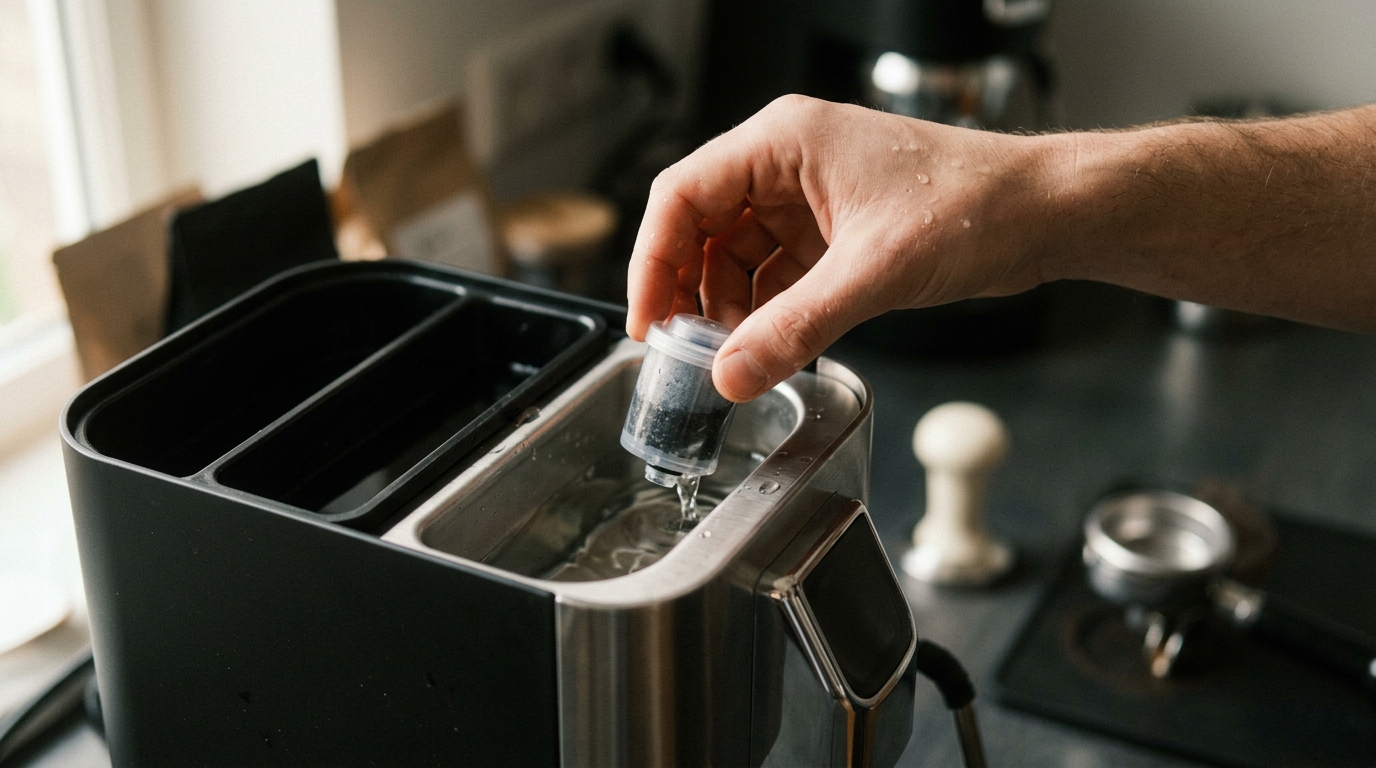
Inline filters connect directly to your machine's water line, typically between a plumbed water supply and the machine itself. They are the most convenient option for machines with a direct plumb-in connection because the filtration happens automatically before water ever enters the boiler. Most inline filters use a combination of ion exchange resin and activated carbon. The ion exchange resin swaps calcium and magnesium ions for sodium or hydrogen ions, which do not form scale, while the carbon removes chlorine and chloramines that would otherwise degrade flavor and attack rubber seals over time.
Tank filters drop into or attach to your machine's water reservoir. Brands like BWT make cartridges specifically designed for espresso machines, and many manufacturers including Jura, DeLonghi, and Breville ship their machines with proprietary tank filter cartridges. These are better than nothing, but their surface area is limited compared to inline systems, and their ion exchange capacity exhausts faster. They need replacement every one to three months depending on your water hardness and usage volume.
Reverse osmosis (RO) systems push water through a semipermeable membrane that strips out nearly everything, producing water with a TDS of 5 to 20 ppm. This is too low for espresso without remineralization. Some RO setups include a remineralization stage that adds back controlled amounts of magnesium and calcium, and these can produce excellent water. However, RO systems waste a significant amount of water in the filtration process, require undercounter installation, and represent a more substantial setup than most home baristas need. If you are already running RO water for other reasons, a remineralization cartridge or using a measured ratio of RO to tap water can work well.
The Filters Worth Using
For machines with water reservoirs, the BWT Penguin and BWT's Bestsave S and M cartridges are among the better options available. BWT's technology uses a magnesium-enriched ion exchange process that substitutes calcium (scale-forming) ions with magnesium ions, which stay in solution and actually contribute positively to extraction flavor. Magnesium ions are known to form stronger bonds with certain aromatic compounds in coffee, which is part of why water with moderate magnesium content tends to produce more flavorful espresso than sodium-softened water.
For plumbed machines, the Everpure H-104 and the BWT BestHead Flex inline system are both respected options used by commercial and prosumer setups alike. Everpure has decades of foodservice filtration behind it, and the H-104 handles scale inhibition through polyphosphate dosing alongside its activated carbon block, which keeps minerals in suspension rather than allowing them to deposit. This is a different mechanism from ion exchange but effective for machines that see high daily volume.
The Kinetico Mach 2030s is worth mentioning for high-end home setups with plumbed dual boiler machines. It uses a twin-tank ion exchange system that regenerates automatically and can handle harder water supplies without the breakthrough issues that single-cartridge systems experience toward the end of their service life.
Matching the Filter to Your Water Hardness
Before buying any filter, test your water. You can order a TDS meter for under $15, or buy proper water hardness test strips that measure in grains per gallon or ppm of calcium carbonate. Your municipal water supplier is also required to publish annual water quality reports, which will give you a baseline. Water hardness above 200 ppm calcium carbonate is considered hard and will exhaust ion exchange cartridges quickly. Water in the 50 to 150 ppm range is easier to manage and gives you more flexibility in filter choice.
If you are in a very hard water area, a single tank cartridge filter is not going to cut it. You will be replacing cartridges every few weeks, which defeats the economic argument for using them. In that scenario, an inline filter with a larger resin bed, or a proper water softening setup, makes more financial sense over a year of operation.
Filter Maintenance Is as Important as Filter Choice
A filter that is past its service life is not a neutral object. An exhausted ion exchange resin can actually begin releasing previously captured calcium ions back into your water, a process called ion dumping. You can end up with harder water coming out than going in. Most cartridges are rated for a volume of water (often 1,000 to 2,000 liters) or a time period, and you should track whichever limit you hit first. If you are using a machine with a built-in filter change indicator, be aware that these are typically calibrated to average water hardness and average usage, not your specific conditions.
Keeping a log of your filter changes, water usage, and descaling intervals tells you a lot about whether your filtration setup is actually working. If you are still needing to descale every two months despite running a filter, either the filter is undersized for your water or it is being replaced too infrequently. This kind of tracking is straightforward to do manually, and it is exactly the type of variable I built logging tools around at grindset.cafe for baristas who want to connect equipment maintenance to shot quality over time.
The Bottom Line
The right water filter depends on your machine type, your local water hardness, and your usage volume. For most home baristas with reservoir machines in moderate hardness areas, a BWT magnesium-enriched cartridge is a solid, well-researched choice. For plumbed prosumer machines, an inline filter like the Everpure H-104 or BWT BestHead Flex provides better capacity and more consistent performance. Wherever you land, the investment in filtration is orders of magnitude cheaper than a boiler replacement or a service call for a failed heating element, and the water quality improvement you get in the cup is a real, measurable benefit rather than a marketing claim.