How Tracking Your Espresso Shots Reveals the Patterns That Improve Your Consistency and Technique
By the Grindset team · April 22, 2026 · 6 min read
The Problem With Pulling Shots From Memory
Most home baristas and even many professionals operate on a system that feels more reliable than it actually is: they remember what worked last time, make adjustments based on intuition, and hope the result lands somewhere near the target. This works well enough when everything is constant, but espresso is not a constant system. Your beans are aging day by day, losing CO2 and changing how they resist water flow. Your ambient temperature and humidity shift between morning and afternoon. Your grinder burrs warm up over a session. Without a written record, you are making decisions based on a mental model that cannot possibly account for all of these moving variables simultaneously.
The moment you start writing things down, even basic parameters like dose, yield, and time, you create something your memory cannot: a searchable, comparable record of what actually happened versus what you thought happened. These are frequently different things. Most people who start tracking shots are surprised to discover how inconsistently they were actually hitting their targets, even on days when the espresso tasted fine.
What Tracking Actually Tells You
A single shot log entry is not very useful in isolation. The value accumulates over time, as patterns emerge that would be invisible in a week-by-week mental recollection. When you have 30 or 60 logged shots from the same bag of beans, you can see how your grind setting drifted as the coffee degassed. You can see whether your 9:00 AM shots consistently run faster than your afternoon pulls, which would suggest that your grinder's burr temperature is a real factor in your workflow. You can trace a sequence of adjustments that improved taste and work backward to understand which variable actually mattered.
The most instructive thing tracking reveals is the relationship between your input variables and your output variables. In espresso, the primary inputs you control are dose (grams of dry coffee), yield (grams of liquid espresso), brew temperature (in Celsius or Fahrenheit, ideally measured at the puck), and grind setting. The primary outputs are time, flow behavior, and taste. When you log both sides of that equation consistently, you start to see which inputs have the most leverage over which outputs. For most setups, grind size has the largest effect on shot time, while yield ratio has the largest effect on perceived strength and extraction character. But you will not fully believe that until you have seen it in your own data.
The Minimum Viable Shot Log
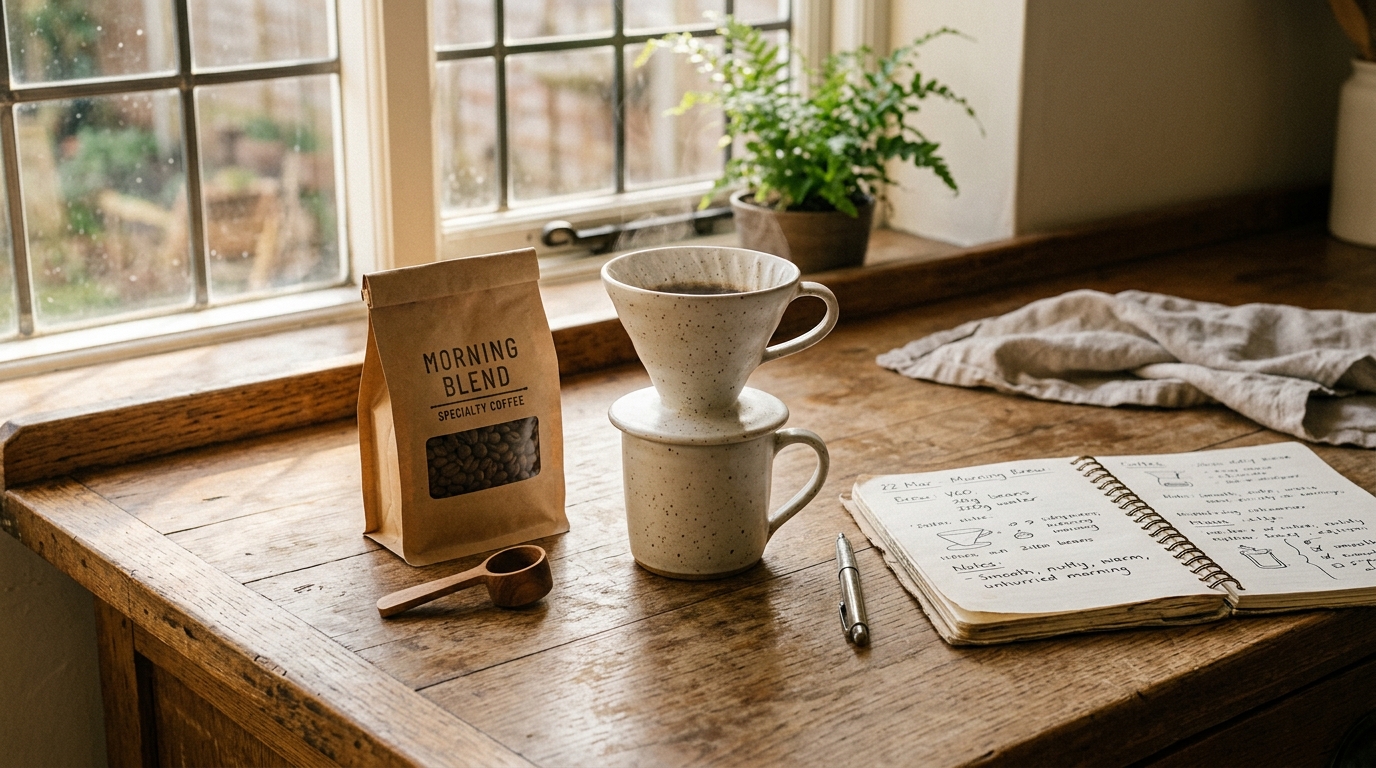
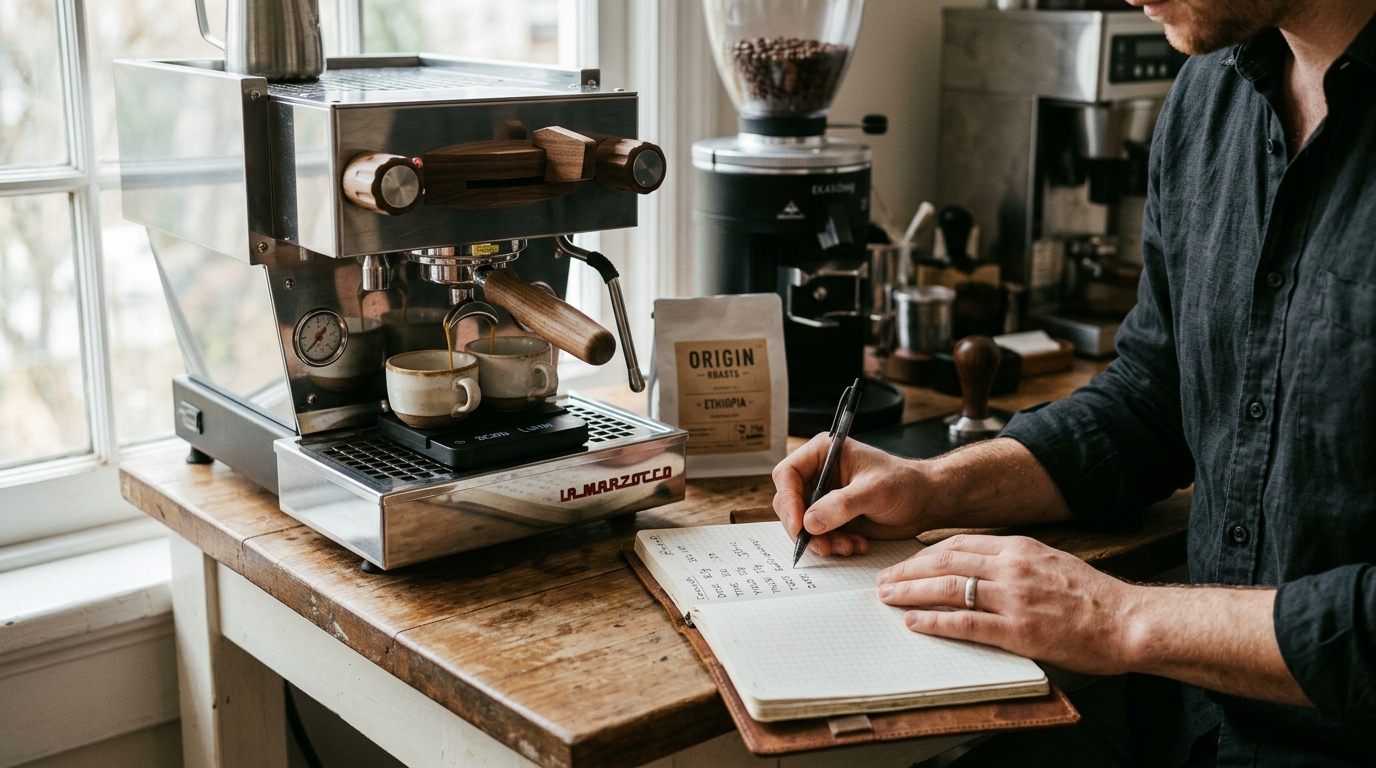
You do not need elaborate equipment or software to start tracking effectively. A notebook and a reliable scale get you most of the way there. The minimum fields worth recording for every shot are: date and time of day, bean name and roast date, grinder setting, dose in grams, yield in grams, total shot time in seconds, brew temperature if your machine allows you to set it, and a brief tasting note. That last field is the one people are most tempted to skip, but it is actually the most important feedback signal you have. Numbers without a sensory evaluation are incomplete. A 27-second shot at a 1:2.2 ratio can taste sour and thin or rich and balanced depending on a dozen factors, and your palate is the only instrument that resolves that ambiguity.
If you want to go further, logging your pre-infusion time (if your machine supports it), water hardness, and room temperature will give you more explanatory power when you are troubleshooting an unexpected shift in behavior. These are not required from day one, but they become relevant once you have ruled out the major variables and are chasing smaller sources of inconsistency.
How to Use Your Log to Make Better Adjustments
The most common mistake when dialing in espresso is changing too many variables at once. If you adjust your grind finer, increase your dose by 0.5 grams, and drop your temperature by 2 degrees Celsius all in the same shot, and the result is better, you have learned almost nothing about which change was responsible. Tracking enforces discipline here, because when you can see your previous shots laid out in sequence, it becomes uncomfortable to make multi-variable changes. You start naturally moving toward single-variable adjustments, which is exactly the methodology that produces real understanding of your setup.
A useful practice when working through a new bag is to lock down your dose and temperature first, then use grind setting as your primary variable until you land in a shot time range you are targeting, typically somewhere between 25 and 35 seconds for most espresso styles at a 1:2 to 1:2.5 ratio. Once your time is stable, you can experiment with yield to adjust extraction character. Logging each step makes it possible to retrace your path if a later adjustment makes things worse. Without logs, that retracing is guesswork.
Understanding What the Patterns Mean Chemically
When you start seeing patterns in your log, it helps to understand what is actually happening at the extraction level. Espresso extracts compounds in a roughly sequential order: acids and lighter fruity compounds extract early, sweetness and body-contributing compounds extract through the middle of the shot, and bitter, astringent compounds extract last. This is why a shot that runs too fast tends to taste sour and underdeveloped, while one that runs too long or extracts too aggressively tastes harsh and dry. Your logged shot times and taste notes, taken together, are essentially a rough map of where in that extraction sequence you are landing.
Water temperature affects extraction rate significantly. Moving from 92 degrees Celsius (197.6 degrees Fahrenheit) to 96 degrees Celsius (204.8 degrees Fahrenheit) accelerates the solubility of nearly all extractable compounds, which is why higher temperatures can rescue an underdeveloped shot from a light roast, while the same adjustment can push a darker roast into bitterness. When you have logged enough shots at different temperatures with the same beans, you will see this relationship in your own tasting notes rather than just accepting it as received wisdom from someone else's setup.
Building Skill That Transfers
The long-term value of shot tracking is not just about optimizing any single bag of coffee. It is about building a mental model of espresso that is grounded in your actual experience rather than in generalized advice. After six months of consistent logging, you will start to recognize patterns across different beans and roast levels. You will develop calibrated intuitions about how a certain grind texture feels on your fingertips compared to the shot time it produces. You will understand your machine's thermal behavior well enough to predict when a first shot of the morning will pull differently than your third shot. These are skills that take years to develop through informal experience but can be accelerated significantly when you have a structured record to learn from.
If you are looking for a structured way to maintain this kind of record, grindset.cafe was built specifically around shot logging for home baristas who want to build that feedback loop without a lot of friction. But whether you use an app, a spreadsheet, or a paper notebook, the act of writing it down is what matters. The patterns are already there in your shots. You just need a way to see them.