How Your Tamper's Levelness and Pressure Directly Affect Espresso Extraction Consistency
By the Grindset team · April 6, 2026 · 7 min read
The Puck Is a Filter, and Filters Have to Be Uniform
When you compress ground coffee into a portafilter basket, you are creating a porous filter bed through which pressurized water will travel at roughly 9 bars. Water, like any fluid moving through a porous medium, follows the path of least resistance. If your coffee puck has any variation in density across its surface, whether from uneven distribution, poor technique, or a substandard tamper, the water will preferentially channel through the looser areas. That channeling means some coffee grounds are over-extracted while others barely see any water at all. The shot in your cup is then a blend of astringent bitterness and thin, underdeveloped flavor. This is not a grind problem. This is not a recipe problem. It is a contact-uniformity problem, and the tamper is the tool responsible for solving it.
Most people underestimate the tamper because it looks simple. It is a metal cylinder with a handle. But the geometry and the mechanics of how it makes contact with the coffee bed determine whether extraction is reproducible from shot to shot. Two variables matter above everything else: the levelness of the tamp and the consistency of applied pressure. Get both right, and you have removed one of the largest sources of shot-to-shot variance in your workflow.
What "Level" Actually Means at the Puck Surface
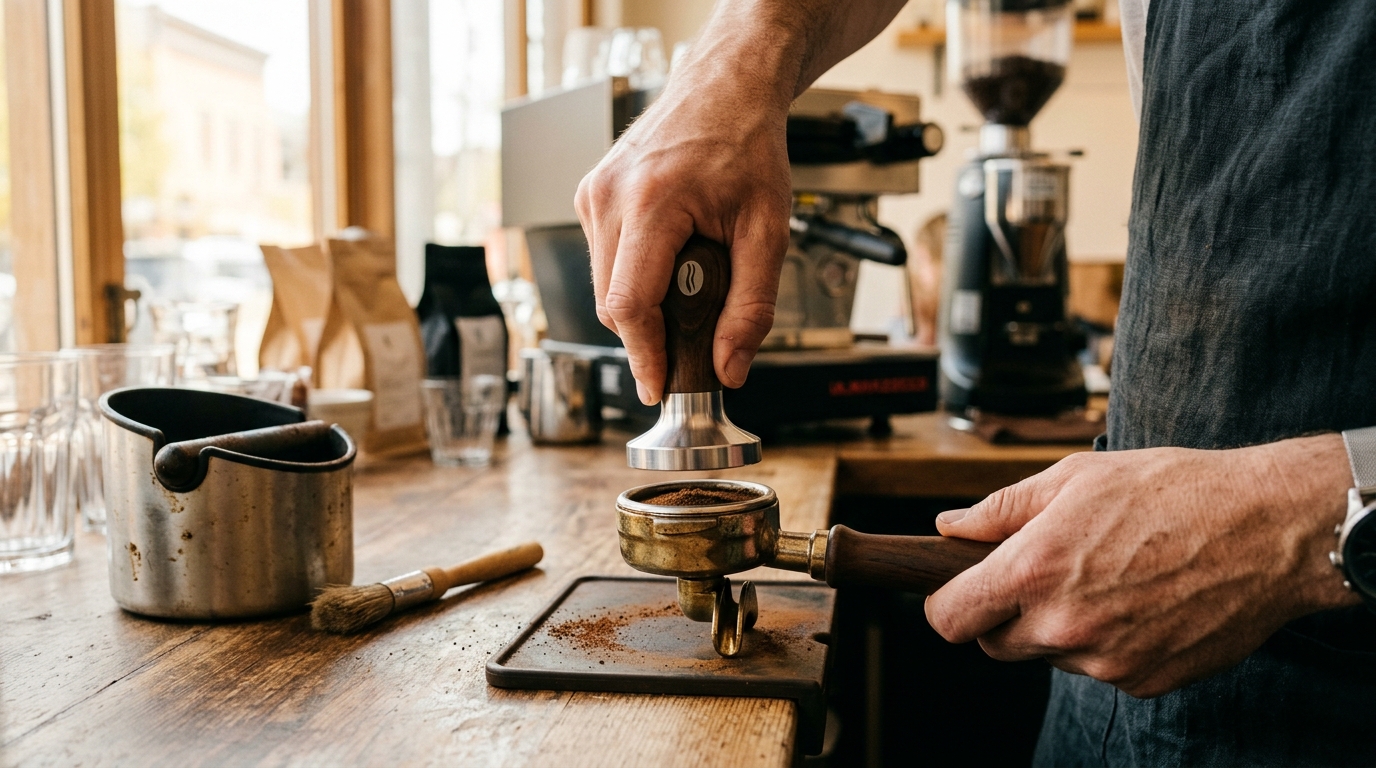
A level tamp means the base of the tamper is parallel to the rim of the portafilter basket when you apply downward force. Even a 2 to 3 degree angle across a 58mm basket creates a measurable difference in puck depth from one side to the other. If the high side of the puck is compressed at, say, 8mm depth and the low side sits at 10mm, you now have two distinct densities in the same puck. Water entering through the shower screen at uniform pressure will move faster through the less dense region every single time. You can watch this happen in a naked portafilter: the extraction will be asymmetric, with one side running faster and blonding earlier than the other.
The mechanical reason this happens is straightforward. A denser bed of particles has more surface area per unit volume available for water contact, and it also presents more tortuous flow paths that slow water velocity. A less dense region does the opposite. Slower water through dense zones means longer contact time and higher extraction yield from those grounds, while the loose zones strip soluble compounds quickly and let most of the water pass through underloaded. The result is a shot where the solubles in your cup come from wildly different extraction percentages, averaged together into something muddled and inconsistent.
A cheap, poorly machined tamper with a base that is not truly flat will cause this problem even when your technique is perfect. The tamper face must be flat and perpendicular to the central axis of the handle. This is a manufacturing precision issue, and it is why the $8 plastic tamper that came with your machine should be retired immediately.

Why Pressure Matters, and What Number to Actually Target
The commonly cited target for tamping pressure is around 30 pounds (roughly 13 to 14 kilograms) of downward force. This figure has been repeated so many times it has calcified into dogma, and the research behind it is thinner than most people assume. What the 30-pound guideline is actually getting at is something more useful: once you exceed a relatively modest threshold of pressure, additional force does not meaningfully change puck density. Coffee grounds, once compressed past a certain point, resist further compaction. What matters far more than hitting an exact force number is hitting the same force number every single time.
Inconsistent pressure creates inconsistent puck density shot to shot. If you tamp at 20 pounds on one pull and 40 pounds on the next, you have changed the puck's resistance to flow and therefore its extraction behavior, even though everything else in your recipe is identical. The grind setting, dose weight, and brew temperature are all held constant, but the puck structure is different, so the output will be different. This is why calibrated tampers, which click or stop at a preset force threshold, exist and have genuine utility. They are not gimmicks. They solve a real repeatability problem for anyone whose manual tamp force drifts during a busy service or an early morning routine.
That said, a calibrated tamper is only useful if it is also level. Force consistency without geometric consistency still gives you channeling. You need both.
Tamper Fit: Why Diameter Is Not Optional
A tamper that is even 0.5mm undersized for your basket leaves an annular gap around the perimeter of the puck. Water entering the puck from the shower screen can bypass the compressed coffee entirely by traveling down that gap along the basket wall and through the bottom of the puck at the edges. This is sometimes called perimeter channeling, and it is particularly insidious because the center of the shot can look and taste reasonably normal while a significant fraction of your water is doing essentially nothing useful.
Standard basket diameters are not as standardized as the name implies. A 58mm basket from one manufacturer may actually measure 58.3mm or 57.9mm internally. This means the right tamper for a VST basket is not necessarily the right tamper for an IMS basket. Measure your basket before buying. A tamper that fits with just a slight amount of resistance, able to drop in cleanly but without obvious play, is what you want. Many specialty tamper manufacturers offer half-millimeter sizing increments specifically for this reason.
Handle Ergonomics and Long-Term Technique
There is a practical dimension to tamper design that does not get enough attention: if the handle is uncomfortable or poorly balanced, your technique will drift over time, especially across multiple shots. A handle that forces your wrist into an awkward angle makes consistent levelness harder to maintain. A handle that is too light gives poor feedback about when the tamper base has made full contact with the coffee surface. Heavier, well-balanced tampers with a flat or slightly concave base allow you to feel the puck surface engage, which is genuine tactile feedback about your distribution before you apply full pressure.
Bottomless or convex tamper bases were popular for a period but have largely fallen out of favor in specialty circles for good reason: a flat base, machined to a tight tolerance, is easier to use correctly and produces more predictable results. The physics of uniform compression favor a flat-on-flat contact geometry.
Putting It Into Practice
- Check your tamper base with a machinist's straightedge or a flat surface if you have any doubts about its flatness.
- Measure your basket internal diameter before selecting a tamper. Do not assume 58mm means 58.0mm.
- Practice your tamp on a bathroom scale to calibrate your sense of 30 pounds, then focus on replicating that feel rather than obsessing over the exact number.
- Use a mirror or watch your wrist alignment when tamping to catch lateral tilt before it becomes a habit.
- Distribute your grounds evenly before tamping. A tamper cannot fix poor distribution. It can only preserve it or make it worse.
Tracking your shot parameters alongside your sensory notes is where tools like grindset.cafe become useful. When you log dose, yield, time, and tasting notes consistently, patterns in your extraction inconsistency become visible, and you can start isolating whether variance is coming from your tamp, your grind, or something else entirely.
The tamper is the last mechanical intervention between your prepared grounds and the brew cycle. It deserves the same scrutiny you give your grinder and your water. A well-made tamper, used with repeatable technique, removes a variable that most home baristas are carrying around without realizing it. Fewer variables means more meaningful feedback from each shot, and more meaningful feedback is how you actually get better at pulling espresso.