Manual Espresso Machines: What They Actually Demand From You and Whether You're the Right Owner
By the Grindset team · April 27, 2026 · 6 min read
The Honest Case for Going Manual
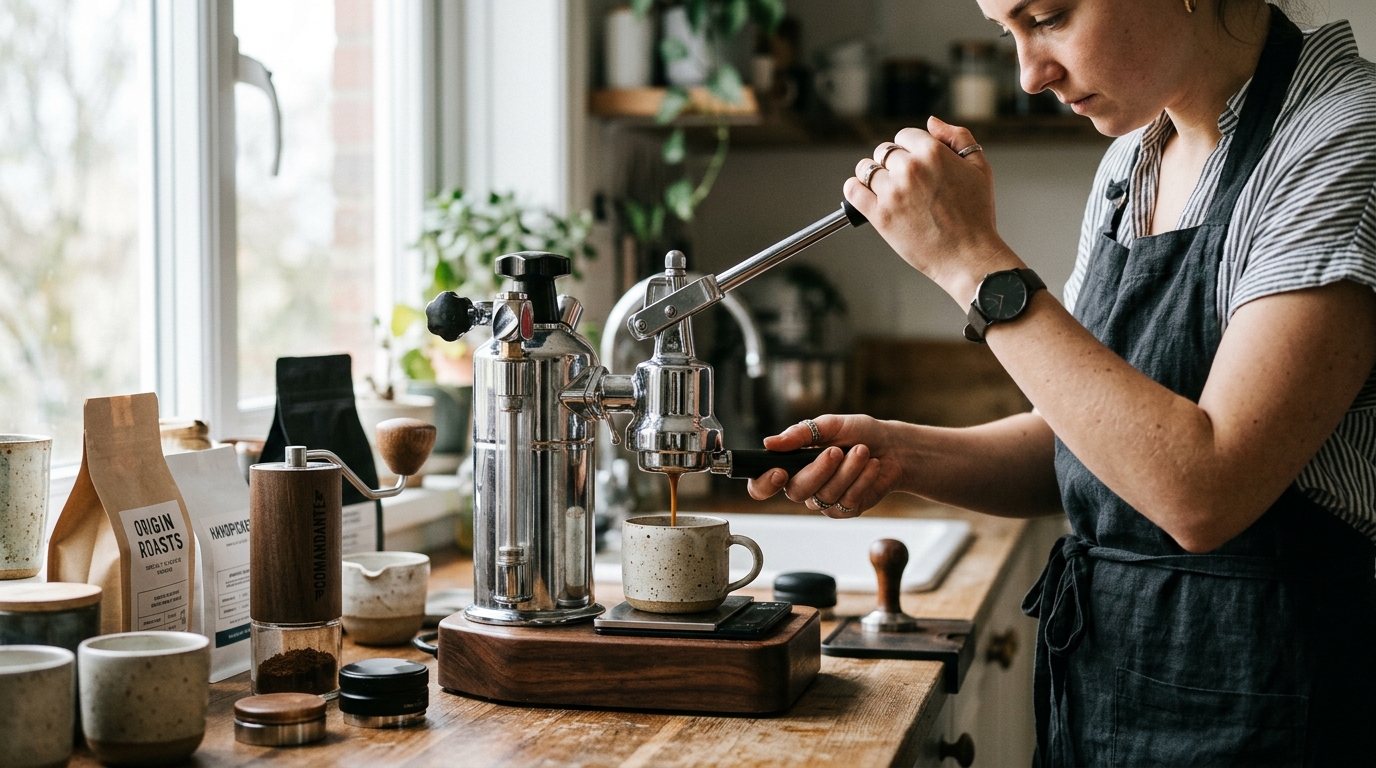
Manual espresso machines occupy a strange corner of the market. They are simultaneously the oldest form of espresso preparation and the most technically demanding thing you can put on a home counter. Before lever machines became electric-pump-assisted, every shot of espresso was pulled by a human hand generating pressure through a piston. That history matters because it tells you something about the skill floor: these machines were designed to be operated by trained baristas who pulled hundreds of shots a day. Buying one for a home kitchen is a different proposition entirely, and it deserves an honest accounting of what you are signing up for.
The appeal is real. A manual machine gives you direct control over pressure profiling in a way that most prosumer pump machines simply cannot replicate without expensive add-ons. When you pull the lever down on a spring-loaded machine, the spring decompresses from roughly 8-12 bar at the start of the pull and tapers naturally as the spring relaxes, creating a pressure curve that many experienced tasters find produces sweeter, more texturally interesting espresso than a flat 9-bar pump extraction. That is not audiophile mythology. There is a measurable reason: varying pressure during extraction changes the rate at which different soluble compounds are released from the puck, and a declining pressure curve in the latter half of extraction can reduce the harshness of over-extracted bitter compounds.
The Two Main Types and What Separates Them
Before you decide whether a manual machine belongs in your life, you need to understand that "manual espresso machine" covers two meaningfully different categories. Spring-loaded lever machines, like the classic Elektra Microcasa a Leva or the ECM Classika Lever, use a spring that you compress by raising the lever. You raise the arm to load the piston against the spring, then allow the spring to push the piston down through the puck. The pressure curve is set by the spring constant, typically around 8 to 9 bar at peak, and you have limited ability to alter it mid-pull beyond slightly varying your grip at the end of the stroke.
Direct lever machines, including the Flair 58 and the La Pavoni Europiccola in manual mode, are a different animal. Here you are the spring. Your hand generates and controls all the pressure throughout the extraction. You can ramp slowly from 2 bar to 9 bar over 10 seconds, hold at 6 bar for the body of the shot, then taper off at the end. This is genuine pressure profiling in the most literal sense. The tradeoff is that consistency requires significant repetition and physical feedback sensitivity. A shot that runs 25 to 30 seconds at a 1:2 ratio, say 18 grams in to 36 grams out, involves sustained, controlled force for that entire window, and achieving the same curve twice in a row takes practice that most people underestimate before buying.
What These Machines Actually Demand From You
Let us be direct about the skill and attention requirements, because marketing for these machines tends to romanticize rather than specify. First, grind quality matters more on a manual machine than almost anywhere else in espresso. Because you are controlling pressure by hand, any inconsistency in the grind distribution creates uneven resistance in the puck, which you will feel through the lever and which will manifest in the cup. A flat burr grinder capable of producing a consistent grind around 200 to 400 microns is not optional. Cheap grinders will punish you more noticeably here than on a pump machine with its regulated pressure.
Second, temperature management on many manual machines, particularly the La Pavoni-style direct levers, is a genuine technical challenge. The group head is heated by the boiler, and it cycles through temperature swings that can span 10 degrees Celsius or more depending on how long you wait between shots and how aggressively you flush. Experienced La Pavoni users develop rituals around thermometer readings, flush timing, and lever technique specifically to manage the group temperature into a stable extraction window, typically somewhere between 92 and 96 degrees Celsius at the puck. Ignoring this produces sour or bitter shots that have nothing to do with your lever technique.
Third, and this is the point that separates people who thrive with these machines from people who resell them within six months: you need to find the diagnostic feedback loop engaging rather than frustrating. When a shot goes wrong on a pump machine with fixed pressure, the variables are relatively constrained: grind, dose, distribution, and temperature. On a direct lever machine, you add pressure curve to that list. Diagnosing a sour 20-second shot requires you to ask whether the issue was grind too coarse, temperature too low, or pressure applied too gently in the first 10 seconds. That added variable is either fascinating or maddening depending on your temperament.
Who Should Actually Buy One
The right owner for a manual machine is someone who has already spent time on a semi-automatic setup and understands the fundamentals of espresso extraction at a working level. If you can reliably diagnose a channeling problem, adjust your grind in 10-micron increments with purpose, and taste the difference between a 25-second and a 35-second extraction at the same ratio, you are ready. If you are still learning whether your espresso is sour or bitter, you are not, and no amount of lever romanticism changes that.
Manual machines also reward people with a consistent daily routine. These are not machines you use twice on Saturday and ignore all week. The boiler needs to reach thermal equilibrium, which takes 20 to 45 minutes depending on the machine, and your technique improves through repetition. Someone pulling one or two shots every morning for months will develop genuinely meaningful lever control. Someone pulling shots on weekend whims will plateau quickly and remain frustrated.
Budget is worth addressing plainly. Quality manual machines start around $400 to $500 for a Flair 58 or similar manual portafilter device, which requires an external heat source for water, up to $1,500 to $3,000 for a boiler-equipped spring lever machine from a reputable European manufacturer. The grinder you pair with any of these should not be an afterthought. A capable flat burr grinder for espresso will cost at least $300 to $500, and skimping there undermines every other advantage a manual machine offers.
The Specific Satisfaction They Offer
None of the demands above are reasons to avoid manual machines if you fit the profile. The specific satisfaction of pulling a technically correct shot on a direct lever, where your hands have managed pressure from pre-infusion through peak extraction to taper, and the cup tastes exactly as you intended, is unlike what you get from pressing a button. You understand what happened mechanically because you were the mechanism. That understanding compounds over time into a refined ability to taste the consequences of your own decisions, which is ultimately what serious espresso making is about.
If you want to track your shots, your ratios, and your extraction notes as you work through the learning curve on a manual machine, grindset.cafe was built precisely for that kind of systematic attention to the variables that matter.
Manual machines are not better or worse than pump machines in some absolute sense. They are better for a specific kind of person: methodical, curious about mechanism, willing to invest in technique rather than rely on automation, and genuinely interested in what the lever is telling them about what is happening inside the puck. If that description fits, the machine will reward you proportionally to the attention you give it.