How Humidity Affects Your Grinder Settings (And How to Adjust for It)
By the Grindset team · April 29, 2026 · 6 min read
Why Your Grinder Doesn't Know What Day It Is
You dial in a shot on Monday morning. Eighteen grams in, thirty-six out, twenty-eight seconds, tastes great. You don't touch anything. Tuesday morning you pull the same shot and it runs in twenty-two seconds, tastes thin and sour. Nothing changed except the weather rolled in overnight and the humidity climbed from 45% to 78%. This is one of the more frustrating parts of working with espresso, because it means that a grind setting is never truly fixed. It's a snapshot of a particular coffee, at a particular roast age, in a particular environment. Humidity is one of the biggest environmental variables, and most home baristas underestimate how much it moves the needle.
What Humidity Is Actually Doing to Your Coffee
Coffee grounds are hygroscopic, meaning they actively absorb moisture from the surrounding air. Ground coffee is especially susceptible because the grinding process fractures the bean structure and dramatically increases surface area, exposing more of the porous internal matrix to ambient air. When grounds absorb moisture, a few things happen simultaneously. The cell walls soften slightly, the grounds become marginally denser and more compressible, and the surface chemistry changes in ways that affect how water flows through the puck.
The practical result is that high humidity causes grounds to clump together more readily and pack more tightly. A tighter, more cohesive puck creates more resistance to water flow, which slows extraction and increases contact time. If you don't adjust, your shot runs long and over-extracts. Conversely, in a dry environment, grounds stay loose and flowable, the puck compacts less, water finds the path of least resistance, and shots run fast and under-extract. The effect is real, measurable, and it happens faster than most people expect, sometimes within minutes of grinding in a high-humidity environment.
Roast level interacts with this too. Darker roasts have more developed cell structure and higher CO2 content relative to freshly roasted light roasts that have had time to off-gas. But at any roast level, the physical response to moisture is the same direction, just potentially different magnitude.
How Much of an Adjustment Are We Talking?
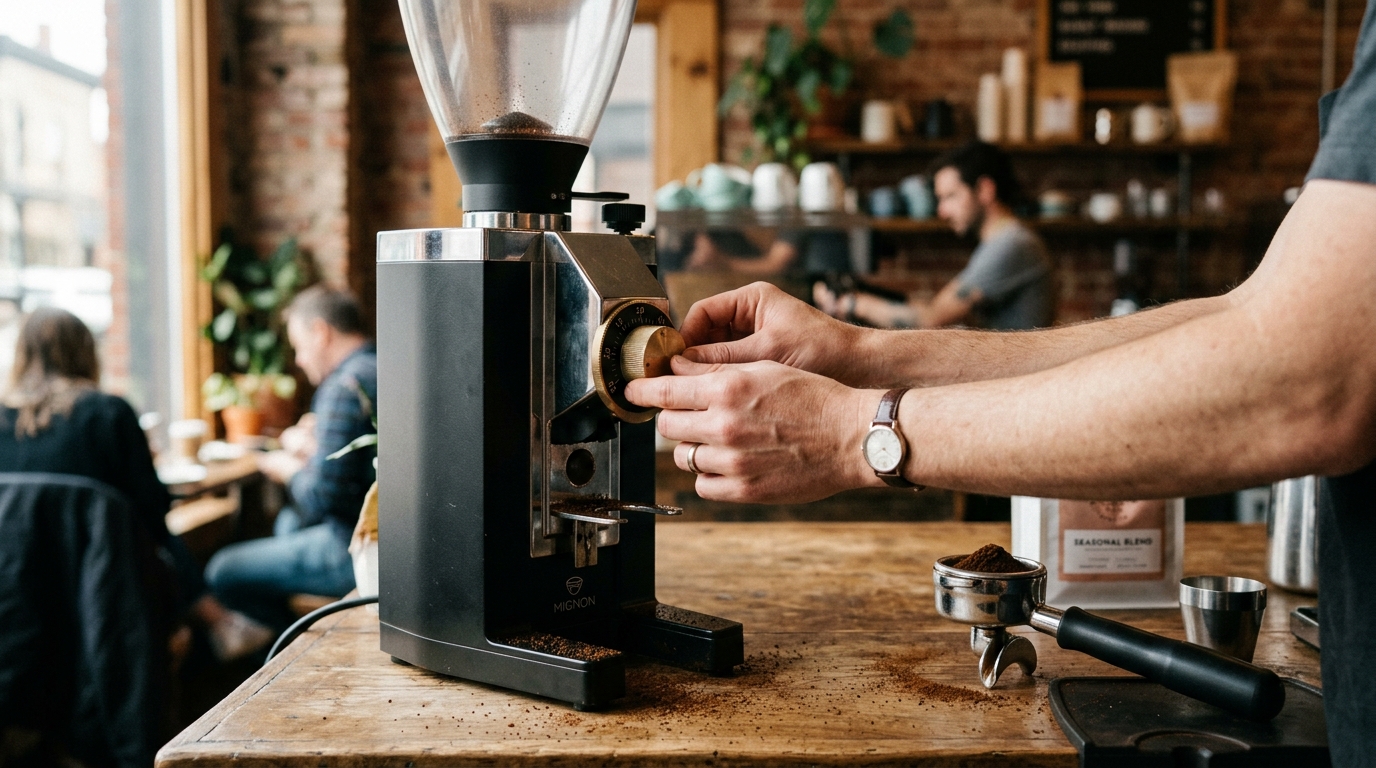
This is where I want to be honest rather than vague. The exact adjustment depends on your grinder, your coffee, and the magnitude of the humidity change. There is no universal number. What I can tell you from consistent experience and from what other serious home baristas report is that a swing from roughly 40% relative humidity to 80% relative humidity might require coarsening your grind by one to two steps on a typical home grinder with a stepped adjustment ring. On a grinder with a continuous adjustment collar, that might be a quarter to half turn depending on the grinder's step resolution.
The reason I frame it as a range rather than a single number is that grinders differ significantly in how their burr geometry responds. Flat burrs and conical burrs don't produce identical particle distributions, and the relationship between a given adjustment increment and the resulting flow rate change varies. The point is that the adjustment is real but modest. You're not recalibrating from scratch every time a cloud rolls over. You're making a small correction and pulling a test shot.
Whole Beans vs. Pre-Ground: A Significant Difference
Whole beans also absorb moisture, but the process is slow because the bean's outer skin limits surface area contact. If you store your beans in a sealed container with low internal humidity, they're reasonably protected until you grind them. Once you grind, the protection is gone entirely. This is why grinding immediately before brewing is important for reasons beyond just preserving aromatics. It minimizes the window during which your grounds are exposed to ambient conditions.
If you grind and then let the grounds sit on the counter for five minutes while you do something else, you're introducing a variable that compounds with ambient humidity. In a humid environment, those grounds are already absorbing moisture and clumping before they ever hit the portafilter. Grind directly into your portafilter or dosing cup and move straight to distribution and tamping.
Practical Signs That Humidity Is Affecting Your Shot
Rather than obsessively monitoring your hygrometer before every shot, it's more practical to read your extraction for signs that something has shifted. Here's what to watch for:
- Shot time increases by more than three to four seconds from your established baseline without any other change.
- The puck feels noticeably wetter or more compressed after the shot, suggesting the grounds absorbed water differently.
- Channeling increases, which can happen when humidity-induced clumping creates uneven density in the puck.
- Flavor shifts toward bitterness or a heavy, muted sweetness, signs of over-extraction from slowed flow.
- Your distribution step feels different, the grounds don't settle or level the same way they usually do.
Any one of these on its own might have another cause. Multiple at once, especially combined with a weather change you noticed, and humidity is a very likely culprit.
How to Adjust Systematically
The process is straightforward. When you suspect humidity is the issue, coarsen your grind by one small increment. Pull a shot and time it against your target. For most espresso recipes, you're targeting a specific output weight in a specific time window, say 36 grams out in 25 to 30 seconds from a 18 gram dose. If one increment doesn't get you there, coarsen slightly more. Resist the urge to make large jumps. Small, consistent corrections preserve your ability to track what's actually happening.
It's also worth knowing your baseline humidity. A simple hygrometer costs almost nothing and tells you a lot. If you know your kitchen typically sits at 55% relative humidity and today it reads 72%, you can anticipate the need for a coarser setting before you even pull the first shot. Over time, you start to internalize these relationships and the adjustments become less effortful.
Some baristas keep a simple log of grind setting, ambient humidity, shot time, and tasting notes. This isn't obsessive behavior, it's pattern recognition. After a few weeks of data you'll know that on humid summer days you run two clicks coarser than your baseline, and that information is repeatable and useful. Grindset.cafe has a shot logging feature built around exactly this kind of systematic tracking, making it easier to spot correlations across sessions rather than relying on memory.
Humidity Is One Variable Among Several
Bean age, roast level, dose weight, water temperature, and distribution technique all interact with your grind setting. Humidity doesn't operate in isolation. A coffee that's three weeks off roast and fully degassed will behave differently under high humidity than the same coffee at five days off roast when CO2 is still vigorously present. The CO2 creates back pressure that partially counteracts slow extraction, which is why very fresh coffee often pulls faster than you'd expect despite a fine grind.
The takeaway isn't that humidity makes espresso impossibly complicated. It's that understanding the physical mechanism helps you respond intelligently rather than randomly. When your shot goes sideways and the forecast shows a front came through, you know where to start. Coarsen slightly, pull again, adjust from there. The coffee didn't change, the air did, and your grinder setting is simply catching up.