Is the La Marzocco Linea Mini Worth the $4,500 Price Tag for Home Baristas?
By the Grindset team · May 24, 2026 · 6 min read
The Machine Everyone Wants and the Question Nobody Answers Honestly
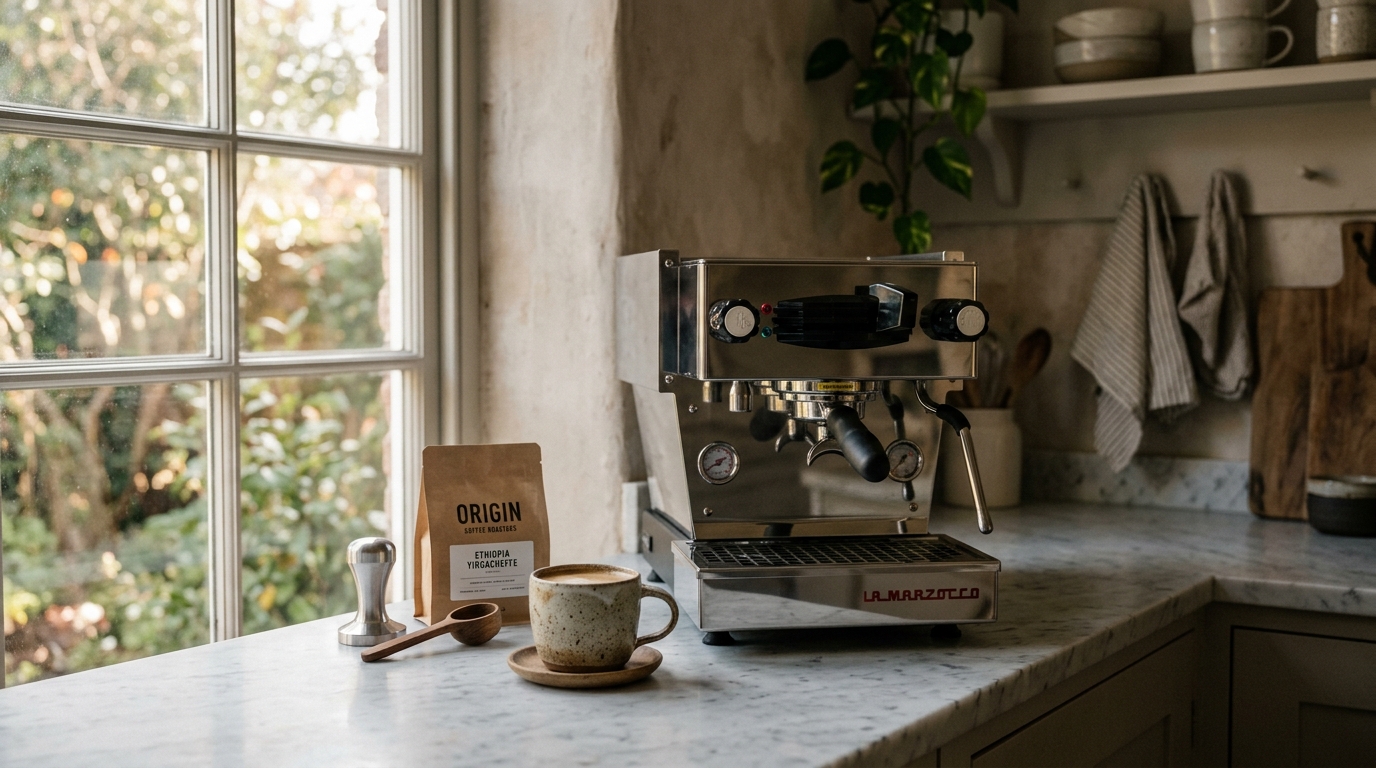
The La Marzocco Linea Mini sits at the top of nearly every home espresso wish list. It looks like a scaled-down commercial machine because it essentially is one, and that heritage carries serious weight in a category full of compromises. But at $4,500, it costs more than most people's first car, and the question of whether it's actually worth that for a home barista deserves a more rigorous answer than "it's La Marzocco, of course it's worth it." The honest answer depends almost entirely on what you already know, what you're trying to accomplish, and how seriously you take the craft.
I've spent time with this machine, and I'll tell you what the marketing won't: it is not a forgiving beginner machine, it does not make mediocre grinders better, and it will not automatically produce better espresso than a well-dialed Breville Barista Express in inexperienced hands. What it will do, for someone who has developed their technique, is remove enough variables from the equation that the remaining ones are almost entirely within your control.
What You're Actually Paying For
The Linea Mini uses a dual boiler system, with separate boilers for brewing and steaming. The brew boiler sits at a stable 200°F (93.3°C) by default, though you can adjust this through the machine's settings. The steam boiler runs around 257°F (125°C). This matters because single boiler and heat exchanger machines require thermal management strategies that eat into your consistency. With the Linea Mini, you can pull a shot and immediately steam milk without waiting for temperature recovery or flushing the group head. The two systems operate independently and maintain their setpoints reliably.
The group head is a saturated group design, meaning the brew boiler water circulates through the group head continuously. In practice, this means the metal mass of the group stays at or very near brew temperature at all times. When you engage the pump, the water hitting your puck is already at the correct temperature, not catching up to it. This is the same design La Marzocco uses in their commercial Linea Classic, which has been in professional cafes for decades. The thermal stability this provides isn't a small thing. Temperature variation during extraction changes the solubility of different compounds in coffee, and even 2 to 3 degrees Fahrenheit of drift can shift your extraction character noticeably.
The build quality is also genuinely commercial-grade. Stainless steel construction, solid brass group components, heavy-duty solenoid valves. This machine will outlast you if you maintain it. La Marzocco has parts and service infrastructure that extends decades. That long tail of serviceability is worth factoring into the price.

Where the Linea Mini Falls Short
There is no pressure profiling or flow profiling on the standard Linea Mini. You get a fixed 9-bar pump pressure, which is traditional and produces excellent espresso, but if you want to experiment with low-pressure pre-infusion ramps or declining pressure profiles in the style popularized by machines like the Decent DE1, you'll need to look elsewhere or add third-party modifications. For most home baristas this is not a real limitation, but it's worth naming because some people in the specialty coffee world treat pressure profiling as the obvious next frontier, and the Linea Mini doesn't go there out of the box.
The built-in pre-infusion is passive and relies on line pressure, not a programmed ramp. Water enters the puck at low pressure before the pump engages fully, which helps saturate the bed before full pressure hits. It works, but it's not adjustable and it's not the same as what you get on more feature-rich machines.
The Linea Mini also has no PID display visible during operation. You can set your brew temperature through a connected app or by navigating settings, but there's no shot timer built into the machine and no real-time feedback while you're pulling. You're working with your eyes, your ears, and a scale. Some people find this clarifying. Others find it frustrating when they're trying to diagnose problems.
The Grinder Problem
This is the part that most reviews gloss over. If you spend $4,500 on a Linea Mini and pair it with a grinder under $500, you are limiting your results in ways that the machine cannot compensate for. Espresso demands particle size distribution consistency at extremely fine settings, and cheaper grinders introduce channeling problems by producing too many fines that compact unevenly or too many coarse particles that create fast paths through the puck. The machine cannot fix a grind distribution problem after the fact.
A realistic pairing for this machine starts with something like the Niche Zero at around $700, or better yet a single-dose grinder like the Lagom P64 or DF64 Gen 2 at similar price points. If you want to run a high-volume home setup with commercial-grade grind consistency, you're looking at a Mazzer or a Eureka Mignon Specialita as entry points. The total cost of ownership for a Linea Mini setup done properly is closer to $6,000 to $7,000 once you factor in a quality grinder, a decent tamper, a distribution tool, a bottomless portafilter, a decent scale with fast response time, and quality water treatment.
Who This Machine Is Actually For
The Linea Mini makes the most sense for someone who has already spent time on a capable mid-range machine, understands how grind size affects extraction, can diagnose channeling from looking at a bottomless portafilter, and is ready to stop fighting their equipment and start refining their technique. If you're at the point where you know your Breville or Rancilio is the ceiling and your skills are beyond it, the Linea Mini is a logical and defensible step.
- You pull at least one or two shots daily and take notes on your extractions
- You understand the relationship between dose, yield, and time (a 18g dose to a 36g yield in 28 to 32 seconds is a reasonable starting framework)
- You've experimented with water chemistry and know your local water's hardness
- You have or are willing to invest in a grinder that matches the machine's capability
- You want a machine you'll still be using in 15 years
If you're newer to espresso and still learning what a well-extracted shot tastes like, the Linea Mini is not where you should start. A Breville Barista Pro or a Rancilio Silvia Pro X at a quarter of the price will teach you more per dollar while you build the foundational skills that the Linea Mini rewards.
The Verdict
The $4,500 price is real, and so is the value. For someone who has outgrown their current setup and is committed to the craft long-term, the Linea Mini offers thermal stability, build quality, and service longevity that cheaper machines simply cannot match. The dual boiler design, saturated group head, and La Marzocco's decades of refinement add up to a machine that stays out of your way so your technique can do the talking.
For someone still developing their skills or unwilling to invest in a matching grinder, it's the wrong purchase at the wrong time. The machine will not hide weak technique behind great engineering. It will show you exactly what you put into it, which is either a feature or a problem depending on where you are in your development as a home barista.
If you're tracking your shots carefully and want to see how your variables connect over time, grindset.cafe has tools built specifically for that kind of systematic logging. The Linea Mini gives you the hardware ceiling. What you do within that ceiling is still up to you.