How Often to Replace Espresso Grinder Burrs (and the Signs That Tell You It's Time)
By the Grindset team · May 31, 2026 · 6 min read
Why Burr Wear Actually Matters
Espresso is, at its core, a high-pressure extraction of a very finely ground coffee bed. The uniformity of that grind matters more in espresso than in almost any other brew method, because small deviations in particle size distribution get amplified by 9 bars of pressure passing through a tightly packed puck. When your burrs are sharp and well-aligned, they fracture coffee cells cleanly, producing a distribution of particles that, while never perfectly uniform, is predictable and manageable. When burrs wear down, the edges round off and start smearing and crushing coffee rather than cutting it. The result is an excess of very fine particles, called fines migration, which can clog the puck unevenly and produce channeling, inconsistent extraction, and flavors that don't match the coffee's potential.

This is not a theoretical concern. The geometry of a burr's cutting edge is engineered to shear coffee at a specific angle and depth. As that edge wears, the burrs compensate by requiring you to close the gap further to achieve the same grind size, which changes the pressure dynamics inside the burr chamber and increases the thermal energy imparted to the grounds. Both outcomes are bad for espresso quality.
The Numbers: What Manufacturers Actually Recommend
Most burr manufacturers publish recommended replacement intervals based on pounds or kilograms of coffee processed. For flat burrs in the 64mm to 80mm range, which cover the bulk of prosumer and commercial espresso grinders, the typical recommendation falls between 500 and 1,000 pounds (roughly 225 to 450 kilograms) of coffee. Conical burrs, which have more surface area engaging the coffee and tend to wear more gradually, often carry recommendations in the 1,000 to 1,500 pound range before replacement is warranted.
To put those numbers in practical terms: if you're a home barista pulling two double shots per day, using approximately 18 grams per shot, you're running about 36 grams of coffee through your grinder daily. That adds up to roughly 13 kilograms per year. At that rate, a set of 64mm flat burrs rated to 300 kilograms could theoretically last over 20 years. But theoretical lifespan and practical performance are different things. Coffee contains oils, silica (from the parchment and chaff), and cellulose fiber, all of which have different abrasive effects on steel. The density and roast level of the coffee also matters: dense, light-roasted beans are significantly harder and wear burrs faster than softer, dark-roasted beans. If you're pulling mostly lightly roasted single origin espresso at home, trim those manufacturer estimates down meaningfully.
For a busy cafe running 10 to 15 kilograms of coffee per day through a commercial grinder, the same burr set might need replacement every 3 to 6 months. Commercial operations should be tracking this by weight, not by time, because volume is the variable that matters.

Signs That Your Burrs Are Past Their Prime
The most reliable indicator is not age or weight throughput but actual shot behavior. Worn burrs produce a characteristic set of symptoms, and if you know what to look for, you can catch the decline before it ruins your workflow.
- Grind setting creep: You find yourself consistently dialing finer over weeks and months to hit the same extraction time. If a shot that used to land at a 9 on your grinder now needs to be at a 7, your burrs are compressing rather than cutting, and you're compensating by closing the gap.
- Increased shot variability: Shots that were previously consistent start showing more run-to-run variation in flow rate and yield, even when dose, tamp pressure, and everything else stays constant. Worn burrs produce less predictable particle distributions.
- Muted or muddy flavor: Espresso pulled from worn burrs often tastes flat, lacking the clarity and brightness it had before. This is partly due to the increase in fines, which over-extract quickly and contribute bitterness, and partly due to the increased heat generated during grinding, which degrades volatile aromatic compounds.
- More clumping and static: As fines increase in proportion, you'll often notice more clumping in the ground coffee and more static electricity buildup. This is a secondary signal rather than a definitive one, since humidity and coffee type also affect clumping, but taken together with other symptoms it's worth noting.
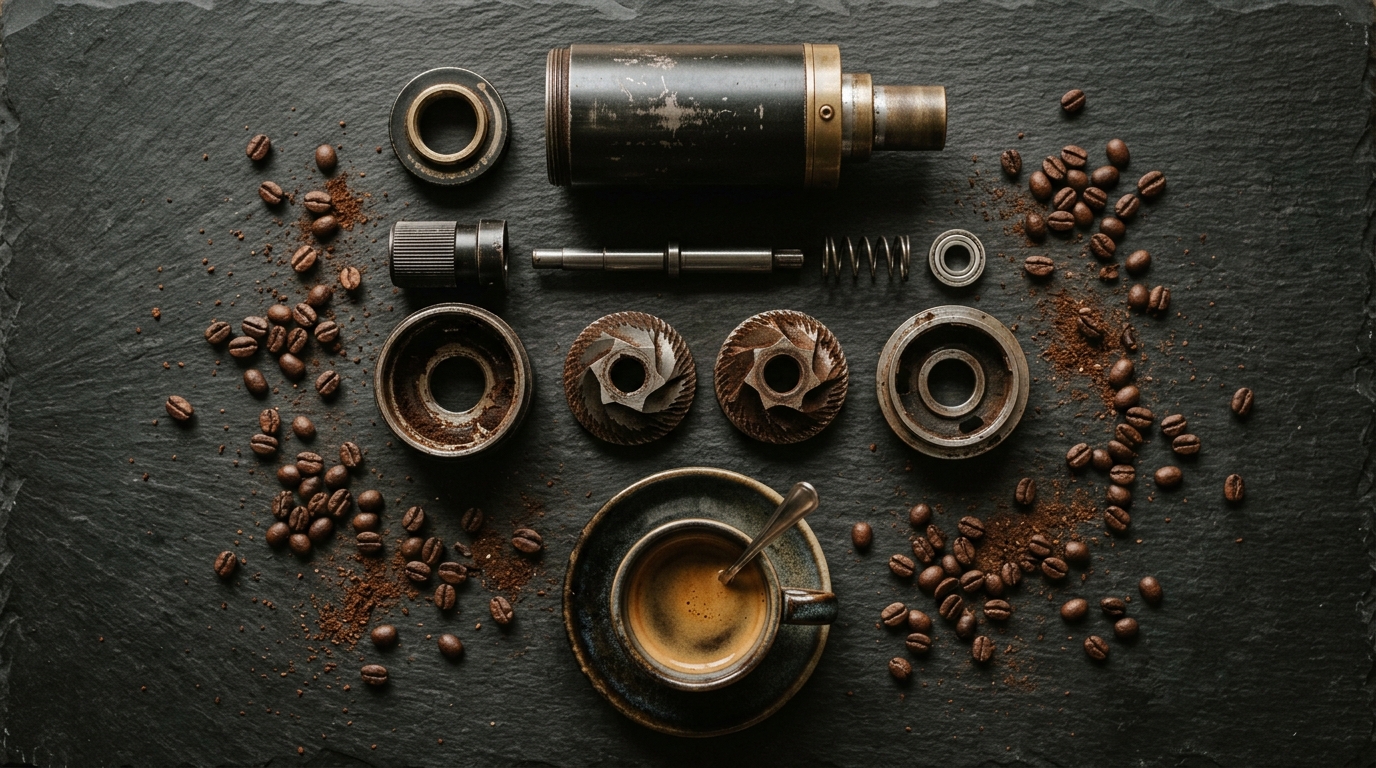
- Visible edge rounding: If you remove the burrs and examine them closely under good lighting, sharp new burrs have a clearly defined cutting edge with geometric precision. Worn burrs show rounding, chipping, and sometimes a polished, glazed look on the cutting surfaces from coffee oils baking onto the steel.
Burr Material Changes the Calculus
Not all burrs wear at the same rate. Standard steel burrs, which come stock in most grinders, are the baseline. Titanium-coated burrs, which some manufacturers offer as an upgrade, have a harder surface layer that extends wear life noticeably, though the coating can eventually chip rather than wear smoothly, which introduces its own performance concerns at extreme age. Some specialty burrs are made from tool steel or high-carbon steel alloys that hold an edge longer. Ceramic burrs, which appear in some lower-end grinders, resist corrosion well but are brittle and can chip suddenly rather than wearing gradually, making them harder to evaluate by performance alone.
For most home espresso setups running standard steel burrs, I think the practical answer is to inspect and evaluate around the 300 to 400 kilogram mark regardless of what the specs say, and to replace if you're seeing any of the performance symptoms above. Waiting for a grinder to fall off a cliff before replacing burrs means you've already pulled a lot of poor shots.
How to Track Your Throughput Without Obsessing Over It
You don't need to weigh every dose and log it in a spreadsheet, though if that's your approach, it works perfectly. A simpler method: estimate your average daily dose weight multiplied by the number of shots per day, then note the date you installed your current burrs. Every six months, do a rough calculation and compare to your manufacturer's threshold. If you're a high-volume home user or a small cafe, set a calendar reminder to inspect burrs at the 200 kilogram mark and assess from there.
Grindset.cafe has a built-in shot logging feature that lets you track cumulative grind weight over time, which takes the guesswork out of this entirely if you're already logging your pulls.
Replacement Is Cheaper Than You Think
Burr replacement for most prosumer flat burr grinders runs between $50 and $150 for a set of quality replacement burrs, depending on the grinder and the burr material. That's a small cost relative to the price of the grinder itself and the coffee you run through it. If you've spent $600 on an espresso grinder and are pulling $25-per-bag specialty coffee through it, letting the burrs degrade to the point of meaningfully compromising extraction quality is not a frugal decision. A fresh set of burrs can make an older grinder feel like new hardware, particularly if you've been experiencing that slow grind-setting creep without realizing what was causing it.
When you do replace burrs, clean the burr chamber thoroughly first. Old coffee oils and debris accumulate in the chamber and on the carrier, and putting sharp new burrs into a dirty environment just accelerates the contamination of fresh grounds. Run a few grams of coffee through as a seasoning pass before pulling your first real shot on new burrs, since fresh burrs can throw off metallic taste notes for the first 50 to 100 grams while the surfaces seat and any machining residue clears.