How the Rancilio Silvia Pro X Brought True Dual Boiler Performance Under $1,500 and Reset Buyer Expectations
By the Grindset team · November 1, 2026 · 6 min read
The Price Wall That Used to Exist
For most of espresso's modern history, owning a dual boiler machine meant spending at least $2,000, and more realistically $3,000 or more. The Rocket R58, the Breville Dual Boiler, the ECM Synchronika — these machines were aspirational purchases, the kind you budgeted toward for a year or two. The thermal logic behind this was sound: two separate boilers, one locked at brewing temperature and one maintaining steam pressure, require precise control electronics, quality solenoids, and enough stainless or brass mass to stay thermally stable. That hardware costs money to engineer and manufacture correctly. Budget alternatives existed, but they almost universally compromised on something critical — PID accuracy, steam boiler capacity, build quality, or all three.
The single boiler with offset temperature and the heat exchanger machine occupied the middle ground. HX machines in particular became popular precisely because they promised near-simultaneous brewing and steaming from one boiler, but they come with their own management overhead. Flushing the group to drop the temperature before pulling a shot, managing thermosyphon flow, reading the pressure gauge and waiting for the right window — these are learnable skills, but they add friction to the workflow. Many home baristas wanted the simplicity of set-it-and-forget-it brewing temperatures without paying $2,500 for the privilege. The Rancilio Silvia Pro X entered that gap and closed it in a way no machine had managed before at its price point.
What the Silvia Pro X Actually Is
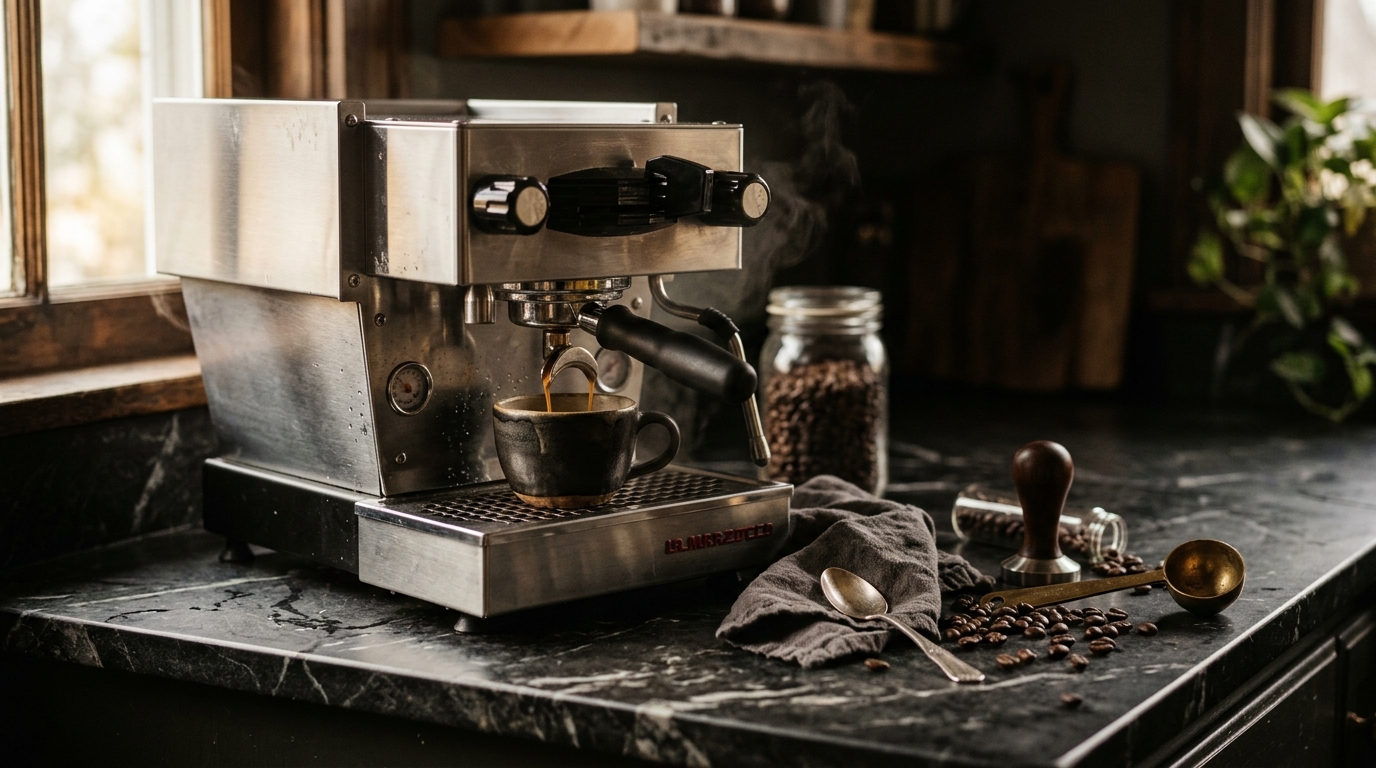
The Silvia Pro X is a true dual boiler machine, not a dual thermoblock, not a thermocoil with a secondary reservoir — two dedicated stainless steel boilers with independent PID control. The brew boiler is small by commercial standards, but it holds temperature with the kind of consistency that matters when you're trying to dial in a light roast at 200°F (93.3°C) versus a darker roast at 195°F (90.5°C). The steam boiler runs separately, which means you can steam milk without affecting your brew temperature at all. This is the fundamental mechanical advantage of the dual boiler architecture: the two thermal systems never interfere with each other.
The machine ships with a pre-infusion function, where the pump runs at reduced pressure for a configurable duration before ramping to full pressure. This matters because pre-infusion allows the dry puck to saturate gradually, which reduces the chance of channeling in the early stages of extraction. It also tends to produce a more uniform extraction across the puck, particularly with finer grinds or lighter roasts that can resist initial wetting. At a retail price that has settled around $1,400 to $1,500 depending on the retailer, the Silvia Pro X offers these features in a machine that weighs around 30 pounds and is built with the kind of materials Rancilio has been using in commercial equipment for decades.
Why It Reset Expectations for the Category
Before the Silvia Pro X, the Breville Dual Boiler (BDB) was the main answer to "what's the most capable dual boiler machine under $1,500?" The BDB is a capable machine and it brought features like flow control and shot timing to a mainstream price, but it is built around a fundamentally different philosophy — heavy feature set, lighter materials, more software dependency. The Silvia Pro X took the opposite approach: simpler interface, fewer automated assists, but a build quality that feels like it will outlast several Breville generations. Rancilio's commercial DNA shows up in the group head, the portafilter, and the frame construction in ways that matter for longevity.
The effect on buyer expectations was real and measurable in how the community started talking about machines. Threads that used to treat $2,000 as the entry point for "serious" dual boiler performance started citing the Silvia Pro X as evidence that $1,500 was achievable without significant compromise. Manufacturers noticed. The category between $800 and $1,500 became more competitive almost immediately, with more brands justifying dual boiler or PID-controlled brew systems in machines that would previously have shipped with simple thermostat control. When one manufacturer proves that a price point is viable, it compresses margin across the whole segment and forces others to respond.
The Thermal Reality of What You're Getting
The Silvia Pro X brew boiler reaches its set temperature and holds it within about 1°C in normal conditions. That level of stability is sufficient for consistent extraction across a session, meaning your second, fifth, and tenth shot of the morning will brew at the same temperature as your first, assuming the machine is fully warmed up. Full warm-up on this machine takes 20 to 25 minutes for the thermal mass to stabilize, which is worth knowing because pulling shots before the group head and portafilter have fully saturated with heat will produce under-extracted results regardless of what the PID reads. The PID measures boiler temperature, not group temperature, and there is always some thermal gradient between the two.
The steam boiler is generous enough for home milk drinks without the frustrating wait times you get with single boiler machines that need to climb from 200°F (93.3°C) up to 255°F (123.9°C) or higher for adequate steam pressure. With the Silvia Pro X, the steam boiler maintains its setpoint independently, so you can steam immediately after pulling a shot. For a household making two or three milk drinks back-to-back in the morning, this functional independence is not a minor detail. It changes the entire rhythm of the workflow.
Where It Falls Short and What That Means
The Silvia Pro X is not a perfect machine, and pretending otherwise would be doing readers a disservice. The steam wand is a single-hole commercial-style tip, which some users find less forgiving than wider multi-hole tips for microfoam texture. The interface is minimal — there is no shot timer on the machine itself, which means you are pulling out your phone or relying on an external timer for every shot until the timing becomes second nature. There is no flow profiling. For home baristas who want to experiment with pressure curves across the extraction, the Silvia Pro X does not offer that capability, and machines like the Lelit Bianca exist at a higher price point precisely because they do.
What the Silvia Pro X does extremely well is the core task: stable brew temperature, independent steam, commercial-grade build quality, and pre-infusion — all for under $1,500. If those four things match your priorities, no other machine in the category matches it for build confidence and thermal architecture. The limitations are real but they are not hidden; they are the result of deliberate decisions about where to invest the engineering budget.
Where This Leaves the Market
The Silvia Pro X demonstrated that the thermal engineering required for a true dual boiler machine was no longer cost-prohibitive at the $1,500 ceiling. That proof of concept changed what buyers expect when they walk into that price bracket. Machines that previously competed on aesthetics or brand recognition now have to justify their thermal architecture explicitly. If you are tracking shots, dialing in by temperature, and pulling more than two or three shots a day, the dual boiler architecture is almost certainly worth the premium over a single boiler setup, and the Silvia Pro X made that upgrade accessible to a much wider range of buyers.
If you want to keep detailed records of your temperatures, ratios, and extraction times as you work through a dial-in, grindset.cafe has a shot logging workflow built around exactly that kind of iterative process. But regardless of what tools you use, the Silvia Pro X sits at an interesting inflection point in espresso machine history — the moment when "serious thermal control" and "reasonable price" stopped being mutually exclusive.