How Much Caffeine Is in a Double Espresso: The Real Numbers and What Affects Them
By the Grindset team · October 25, 2026 · 6 min read
The Number People Want, and Why It's Complicated
The short answer is that a double espresso contains somewhere between 120 and 185 milligrams of caffeine. If you want a single figure to cite, 142 milligrams is close to the average that shows up across multiple independent lab analyses of specialty espresso drinks. But that range of 120 to 185 mg is not measurement error or sloppy science. It reflects genuine variation in the cup, driven by factors that are entirely within your control as a barista or home brewer. Understanding what moves that number is more useful than memorizing any single figure.
For context, the FDA considers 400 milligrams of caffeine per day a reasonable upper limit for healthy adults. A double espresso at the high end of that range puts you at nearly half that ceiling in a single drink, which matters if you're pulling three or four shots across a day. At the low end, you're at about 30 percent. The difference between a well-extracted double and a poorly extracted one could be 60 to 65 milligrams, which is more than some people get from a full cup of tea.
What a Double Espresso Actually Is
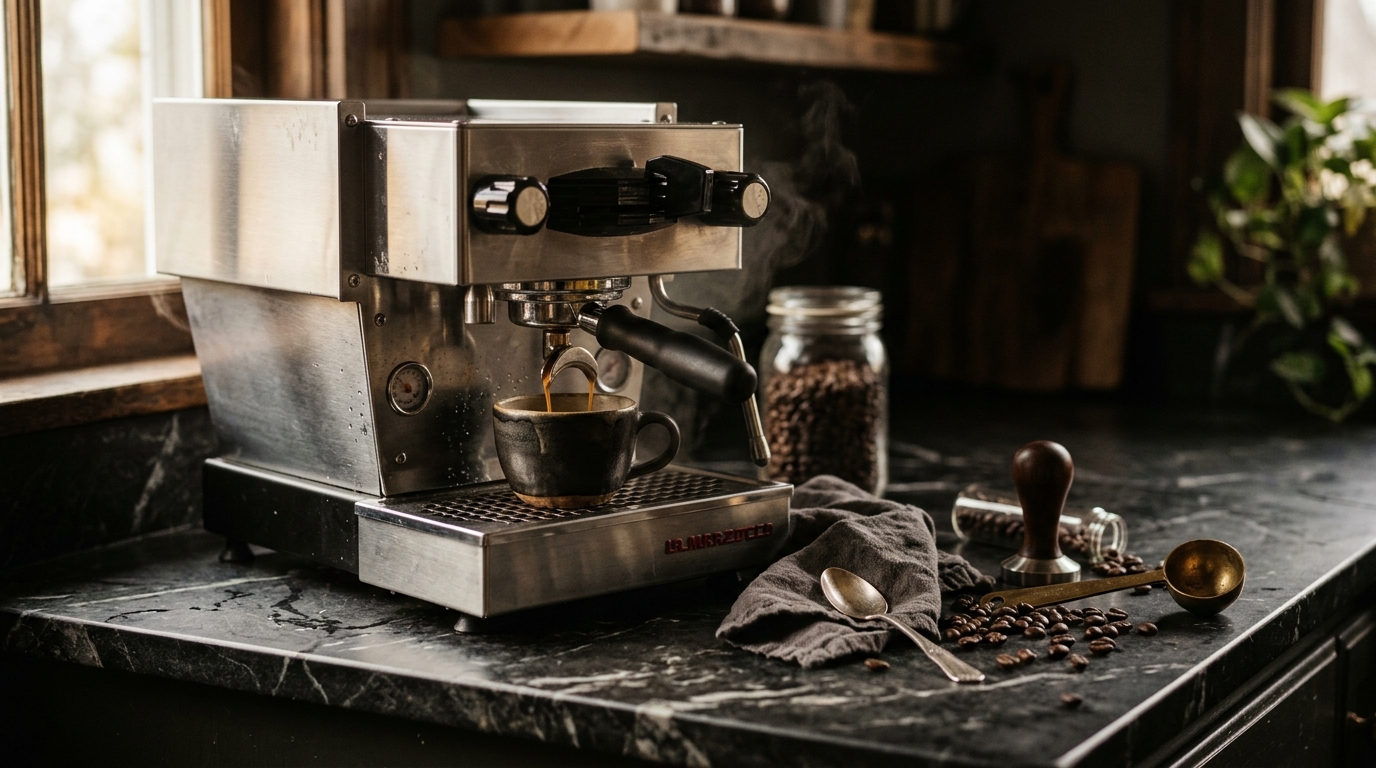
Before the caffeine math makes sense, the dose needs to be defined. A double espresso, or doppio, is traditionally pulled from 14 to 18 grams of ground coffee, yielding 36 to 44 grams of liquid in the cup, in roughly 25 to 30 seconds at around 200 degrees Fahrenheit (93 degrees Celsius). Modern specialty espresso has stretched those parameters considerably, with some recipes running 18 to 20 grams in and 36 to 40 grams out, and others using longer ratios like 1:3 or 1:4 for a more extended, lower-concentration extraction. All of those variables change the caffeine yield in ways that are not always intuitive.
It is worth noting that espresso is not the most caffeinated coffee drink by volume. An 8-ounce drip coffee typically contains 95 to 165 milligrams of caffeine in a much larger liquid volume. Espresso's caffeine density is very high per milliliter, but the serving size is small, which is why the totals are roughly comparable to a standard drip cup despite espresso feeling so much more intense.
The Variables That Actually Move the Number
Caffeine is a water-soluble alkaloid, and its extraction from coffee grounds follows the same general principles as every other soluble compound in espresso. It dissolves into water at a rate influenced by temperature, contact time, particle size, and the concentration gradient between the grounds and the liquid passing through them. Pulling that apart into individual factors gives you a clearer picture of how to think about dosing.
- Dose weight: This is the most direct lever. More coffee in the basket means more caffeine available to extract. An 18-gram dose has roughly 12 to 15 percent more caffeine potential than a 16-gram dose before extraction efficiency is even considered. If you are managing caffeine intake, dose weight is the most predictable variable to adjust.
- Extraction yield: Caffeine is not uniformly distributed through each extraction. It extracts relatively early compared to some compounds, but that does not mean it stops extracting at 20 seconds. Shots pulled to a 1:2 ratio in 25 seconds versus shots pulled to a 1:3 ratio in 35 seconds will differ in total caffeine, though the relationship is not strictly linear because concentration drops as the yield increases.
- Grind size: Finer grinding increases the surface area exposed to water, which accelerates extraction across all soluble compounds including caffeine. A finer grind with a faster flow rate can extract more caffeine in the same time as a coarser grind with a slower flow rate.
- Water temperature: Caffeine solubility increases with temperature. Pulling at 205 degrees Fahrenheit (96 degrees Celsius) rather than 197 degrees Fahrenheit (92 degrees Celsius) will extract a modestly higher caffeine yield from the same puck, all else being equal.
- Roast level: This one surprises people. Light roasts retain slightly more caffeine than dark roasts because the roasting process does degrade some caffeine at very high temperatures, though the difference is much smaller than most assume. More practically, light roast beans are denser and often require finer grind settings to achieve equivalent extraction, which affects the caffeine yield indirectly.
The Bean Variety Factor
Coffea arabica and Coffea canephora (robusta) differ substantially in their baseline caffeine content. Arabica beans contain roughly 1.2 to 1.5 percent caffeine by dry weight, while robusta can run 2.2 to 2.7 percent. This is not a trivial difference. A traditional Italian espresso blend that contains 20 to 30 percent robusta will deliver meaningfully more caffeine per gram of coffee than a single-origin arabica from Ethiopia or Colombia. If you have been drinking specialty single-origin espresso and switch to a traditional Italian bar blend, the same 18-gram dose could deliver 20 to 30 percent more caffeine, which you will likely feel before you calculate it.
Within arabica, there is also variation by cultivar and growing altitude, but these differences are relatively minor compared to the arabica-versus-robusta split. High-altitude arabica tends to develop more slowly and can have slightly higher caffeine concentrations than lower-altitude-grown arabica, but this is a secondary consideration for most practical purposes.
How Milk and Volume Change Your Perception But Not the Math
A cappuccino, flat white, or latte built on a double espresso contains the same caffeine as the espresso itself. The milk adds volume, fat, protein, and texture, but zero additional caffeine and zero caffeine-neutralizing compounds. The reason milk drinks feel smoother and less stimulating has more to do with the slower absorption rate of caffeine when consumed alongside fats and proteins, and the simple dilution of concentration across a larger drink, rather than any actual reduction in caffeine load. If you are tracking intake, the baseline number from the double shot is what matters regardless of what surrounds it.
Putting It Together for Real-World Tracking
If you want a working estimate for your specific setup, start with this framework: multiply your dry dose in grams by 0.008 to get a rough lower-bound caffeine estimate in milligrams, and by 0.011 for an upper-bound estimate assuming good extraction efficiency with arabica. An 18-gram dose gives you a working range of 144 to 198 milligrams using this approximation. For robusta-forward blends, shift those multipliers up to 0.013 and 0.017. These are not laboratory-precise figures, but they are close enough for practical daily tracking and considerably more accurate than generic database values that ignore your specific beans and technique.
I built grindset.cafe partly because I got frustrated with caffeine estimates that ignored all of this context. If you log your shots with dose weight and bean information, the numbers become much more meaningful than a flat "64 mg per shot" figure that appears in most nutrition databases, which refers to a single shot and doesn't account for the factors above.
The practical takeaway is straightforward: if you are pulling 18 grams of quality arabica to a 1:2 ratio with good technique, budget 140 to 160 milligrams of caffeine for your double. If you are using a dark Italian blend with robusta, push that estimate to 160 to 200 milligrams. Those ranges are honest, they are defensible, and they are a much better foundation for managing your daily intake than any single number pulled from a generic source.