Umami in Coffee: The Science Behind the Savory, Brothy Notes in Your Cup
By the Grindset team · June 26, 2026 · 6 min read
The Fifth Taste and Why Coffee Drinkers Keep Reaching for That Word
Spend enough time in serious coffee circles and you will eventually hear someone describe a cup as "brothy," "savory," or even "meaty." These descriptors make some people nod knowingly and others roll their eyes. The question of whether umami is a real, chemically grounded experience in coffee or just a fashionable descriptor borrowed from the food world deserves a serious answer, not a hand-wave in either direction. The short version: there is real science supporting savory, glutamate-driven taste sensations in coffee, but the full picture is more complicated than the specialty coffee community sometimes lets on.
Umami was formally identified in 1908 by Japanese chemist Kikunae Ikeda, who isolated glutamic acid from kombu seaweed and recognized it as a distinct taste separate from sweet, sour, salty, and bitter. The sensation is triggered primarily by free glutamates and certain nucleotides, particularly inosinate and guanylate, which act synergistically with glutamate to amplify the effect. It is a prolonged, mouth-coating, savory sensation that registers differently from the sharp brightness of acidity or the drying pull of bitterness. Humans have dedicated taste receptors for it, specifically the T1R1 and T1R3 receptor complex, so it is not a metaphor or a vibe. It is a physiological response to specific molecules.
What Is Actually in Coffee That Could Trigger Umami
Green coffee beans contain free amino acids, and glutamic acid is among them. Raw arabica beans typically contain somewhere between 0.1 and 0.5 grams of free glutamate per 100 grams of dry matter, depending on variety, processing, and altitude. That is a real, measurable quantity. During roasting, the Maillard reaction consumes a significant portion of those free amino acids as they react with reducing sugars to form hundreds of aromatic and flavor compounds. This is why roasting improves flavor complexity overall but also why lighter roasts, which preserve more of those free amino acids, tend to present more of whatever umami potential the bean had to begin with.
Beyond raw glutamate, coffee contains chlorogenic acids and their degradation products. During roasting and extraction, chlorogenic acids break down into quinic acid and caffeic acid, among others. Quinic acid in particular contributes to the savory, almost soup-like body that some high-grown Central American coffees display, particularly when extracted into a longer, more dilute beverage like a traditional filter brew. This is not the same mechanism as glutamate-driven umami, but the resulting sensation overlaps enough that drinkers reach for the same vocabulary.
There is also the question of nucleotides. Coffee does contain adenosine and related compounds, though most adenosine is bound to caffeine as it degrades, and the free nucleotide concentrations that would synergize strongly with glutamate are not well-documented in extracted espresso at levels comparable to, say, aged parmesan or dried shiitake. The umami in coffee is probably real but likely more subtle than in high-glutamate foods, and that distinction matters if you are trying to understand what you are actually tasting.
Why Espresso Specifically Seems to Trigger Savory Perception
Espresso extracts under pressure, typically 9 bars, at high temperature, around 195 to 205 degrees Fahrenheit (90 to 96 degrees Celsius), and in a compressed time window, usually 25 to 35 seconds. This combination pulls a highly concentrated solution from a relatively small amount of water. A standard 1:2 ratio espresso, 18 grams of coffee yielding 36 grams of liquid, contains soluble compounds at concentrations many times higher than filter coffee. Free amino acids, including glutamate, concentrate accordingly.
There is also the matter of extraction temperature and its effect on protein hydrolysis. Higher brew temperatures facilitate greater breakdown of larger proteins into free amino acids. This is one reason why a very slow, high-temperature extraction can sometimes push a shot toward that brothy character, while an under-extracted, cool shot tastes thin and sour without the round savory background. The savory quality in espresso is partly a product of getting extraction right, which is why it often serves as a positive signal that your parameters are dialed in.
Roast level plays a significant role here too. Lighter roasts preserve more chlorogenic acids and free amino acids, which tends to push toward that bright, almost bouillon-like quality in certain Ethiopian or Yemeni naturals. Medium roasts convert more of those acids and amino acids into aromatic compounds through Maillard browning, resulting in a different kind of savory: darker, more caramelized, less brothy. Heavily dark roasts destroy much of this complexity entirely, leaving mostly carbon-derived bitterness. The umami window in coffee is essentially a light-to-medium roast phenomenon.
Processing and Origin as Variables
Natural and anaerobic processed coffees introduce additional fermentation-derived compounds into the bean. Controlled fermentation can increase free amino acid content, including glutamate, because microbial activity during processing breaks down proteins in the coffee cherry and mucilage. Some anaerobic naturals from producers in Colombia and Ethiopia show remarkably savory profiles, sometimes described as soy sauce, miso, or beef stock, that would be unusual in a washed coffee from the same region. This is not accidental. Extended fermentation at controlled temperatures is producing real chemical changes in the bean's amino acid profile.
High altitude also matters. Coffees grown above 1800 meters tend to have higher concentrations of sucrose and chlorogenic acids due to slower cherry development at cooler temperatures. The same slow development that increases sweetness potential also affects amino acid accumulation in ways that researchers are still working to fully characterize. What the cup record shows empirically is that high-altitude washed coffees from Ethiopia, Kenya, and Yemen consistently produce the savory, brothy, complex cups that inspire umami comparisons.
How to Taste for It Deliberately
If you want to actually notice umami in your espresso rather than just reading about it, a few practical adjustments help. Pull your shot slightly longer than you normally would, something in the 1:2.5 range rather than 1:2, at a temperature toward the higher end of your machine's range. Let the shot rest for 15 to 20 seconds before tasting. The brothy, round, savory quality tends to emerge as volatile acidity dissipates and the cup settles. Pay attention to the aftertaste specifically, because glutamate-driven umami is characterized by its persistence and mouth-coating quality, quite different from the quick fade of citric or malic acid brightness.
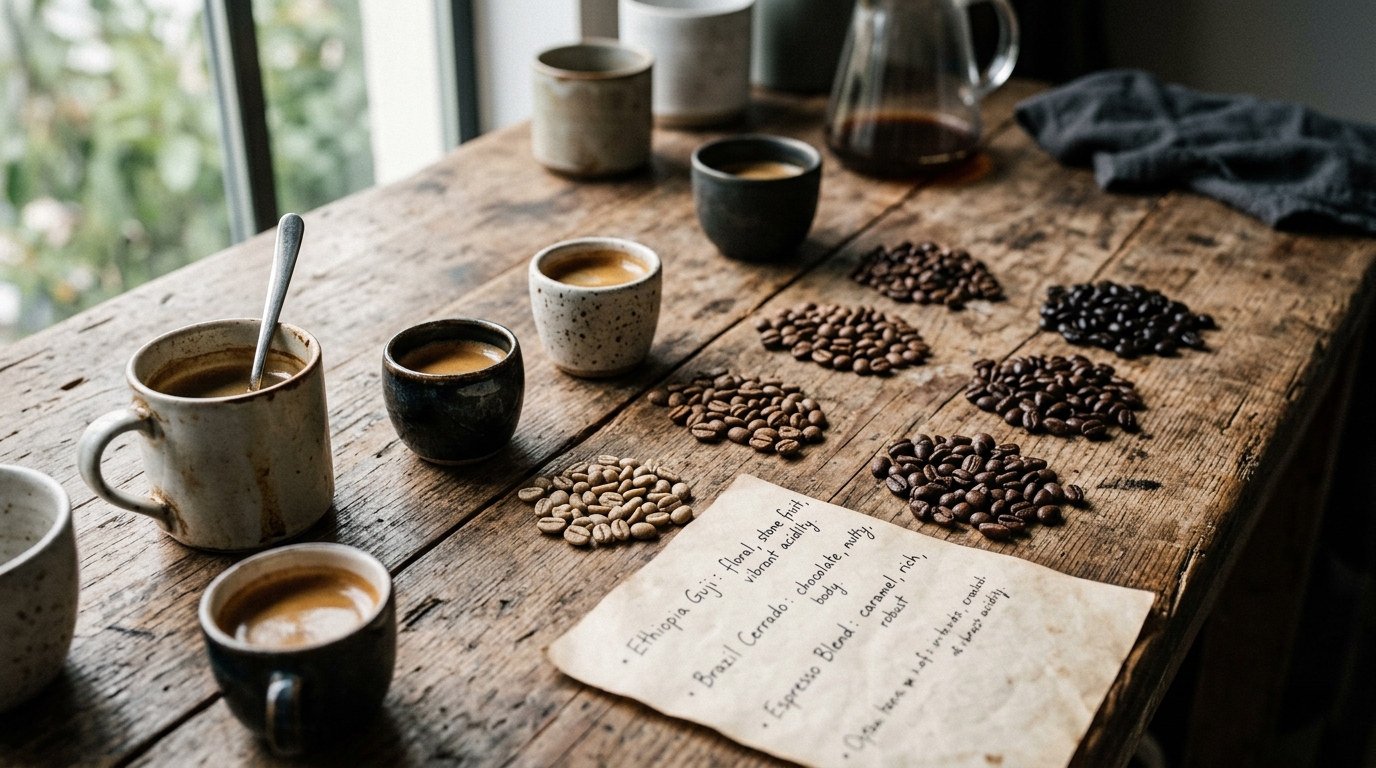
Comparing coffees side by side accelerates your ability to identify this. Put a washed Ethiopian next to a natural Yemeni and pull both at the same parameters. The differences in savory intensity are often striking once you know what to look for. I track this kind of session data in grindset.cafe because having a record of exact parameters alongside tasting notes makes it far easier to isolate what variable actually moved the needle.
The Honest Conclusion
Umami in coffee is real in the sense that coffee contains free glutamates, nucleotides, and chlorogenic acid degradation products that stimulate savory taste perception through documented physiological mechanisms. It is probably more subtle than the enthusiastic descriptor use in specialty coffee suggests, and it is not uniformly present across all coffees or processing methods. Lighter roasts, high altitude origins, natural and anaerobic processing, and careful extraction at appropriate temperatures give you the best chance of actually encountering it. Calling a cup "umami-forward" is not pretension if you understand why it tastes that way. It becomes pretension only when the word is used as decoration rather than as description.