Honey Process Coffee for Espresso: How Partial Mucilage Retention Affects Extraction, Sweetness, and Dialing In
By the Grindset team · September 21, 2026 · 6 min read
What Honey Processing Actually Does to the Bean
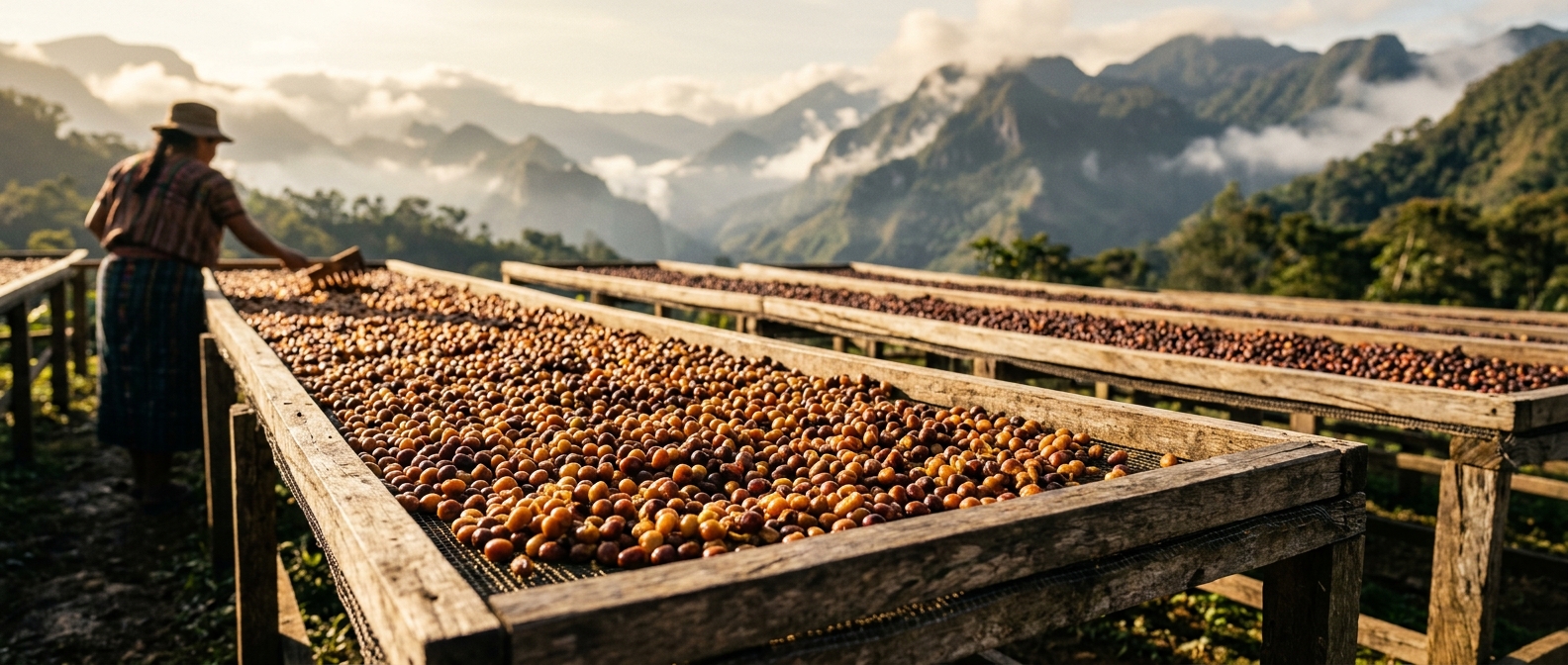
Before you can understand why honey process coffees behave differently under pressure, you need a clear picture of what the processing method actually changes at a structural level. When a coffee cherry is harvested, it has several layers: the outer skin, a layer of mucilage (a sticky, sugar-rich pectin compound), the parchment, and finally the seed itself. Washed coffees have almost all mucilage removed before drying. Natural coffees dry with the entire fruit intact. Honey process sits between those two, with the skin removed but varying amounts of mucilage deliberately left on the parchment before the beans go to the drying beds.

That retained mucilage is the whole story. As the coffee dries over anywhere from 2 to 6 weeks depending on the producer and climate, the sugars and organic acids in that sticky layer migrate into the seed. The degree of retention is typically categorized by color: yellow honey retains perhaps 25 to 50 percent of the mucilage, red honey retains around 50 to 75 percent, and black honey retains up to 100 percent, approaching natural process territory. Each category produces meaningfully different cup characteristics and, critically, different extraction behavior when you're pulling shots.
How Mucilage Retention Changes the Bean's Physical Structure
The drying environment created by high mucilage retention is more controlled and slower than a natural but less oxidative than a washed coffee dried quickly on raised beds. This slower, stickier drying tends to produce a denser bean with higher residual sugar content embedded in the cellular matrix. Density matters enormously for espresso because it directly affects how heat transfers through the puck and how water finds pathways through the ground coffee. A denser bean generally requires finer grinding to achieve equivalent extraction at a given pressure and temperature, though the relationship is not perfectly linear.
The sugars that migrate into the bean during honey processing are primarily fructose and glucose, simple reducing sugars that caramelize readily during roasting. This is why honey process coffees, especially red and black honey, tend to develop more apparent sweetness and body at lighter to medium roast levels compared to washed coffees from the same origin. The Maillard reactions and caramelization that build sweetness and complexity happen with more substrate available. You're not just tasting the roast, you're tasting what the process put into the bean before it ever touched heat.
Extraction Dynamics: What Changes in the Cup
Soluble compound composition in honey process coffees skews differently than in washed or natural coffees. Washed coffees tend to present cleaner acidity because the fermentation and drying are tightly controlled and the mucilage is removed early. Honey process coffees have undergone partial fermentation of the remaining mucilage on the bean, which produces organic acids including acetic and lactic acid compounds, but at lower concentrations than a fully natural processed coffee. The result in the cup is typically a softer acidity with more body and a persistent sweetness that reads as stone fruit, brown sugar, or apricot depending on origin and roast level.
When you're pulling a shot of honey process coffee, you'll often notice that the espresso runs slightly thicker and more viscous than a comparable washed coffee at the same ratio. This is partly due to the higher dissolved solids from the sugar compounds and partly due to differences in how the puck behaves. The additional lipid and sugar content can create a puck that compacts slightly differently, so you may find that your standard grind setting produces higher resistance than expected. This is not a problem, it's a signal to recalibrate.
Dialing In Honey Process Espresso: Specific Adjustments
The most common mistake people make when pulling honey process on a setup calibrated for washed coffees is running the shot too fast because the puck feels normal but extracts differently. A yellow honey from Costa Rica dialed in at the same grind setting as a washed Guatemalan of similar roast level will often produce a shot that tastes sweeter and more syrupy but also muddier or less defined if you don't account for the soluble load. Start by keeping your ratio the same as your baseline, typically 1:2 to 1:2.5, and pay attention to whether the sweetness is clean or if you're picking up a slight fermented or jammy heaviness that suggests under-extraction masking itself as sweetness.
- Pull a baseline shot at your standard settings and assess body and clarity separately. High body with low clarity usually means you need a coarser grind, not a longer shot.
- Temperature is worth adjusting. Honey process coffees often respond well to slightly lower brew temperatures, somewhere around 197 to 200 degrees Fahrenheit (91.5 to 93.5 degrees Celsius), which keeps the sweetness forward without pushing bitter or astringent notes from over-extraction of the more complex organic compounds.
- Extend your ratio before you extend your time. Going from 1:2 to 1:2.3 on a red or black honey often opens up clarity without sacrificing the body that makes the process worthwhile in the first place.
- Watch your pre-infusion. A longer pre-infusion of 5 to 8 seconds at low pressure allows the denser, stickier puck to saturate more evenly before full pressure ramps up, reducing channeling risk significantly.
One thing worth noting is that black honey and natural process coffees get lumped together by a lot of baristas, and that's understandable because the cup profiles can overlap, especially at medium roast levels. But black honey coffees typically have more controlled fermentation and cleaner fruit notes than naturals, which means they respond better to the same precision dialing-in approach you'd use for a washed coffee. Don't just throw up your hands and call it "funky." The complexity in a well-sourced black honey is structured, not chaotic, and it rewards careful work.
Roast Level Considerations
Honey process coffees are forgiving across a range of roast levels in a way that washed coffees are not, but that flexibility has limits. A very light roast on a yellow honey can read as underdeveloped because the delicate fruit acids haven't had enough heat to fully integrate, and you end up chasing a grassy or sharp note through your shot that no amount of grind adjustment will resolve. Medium light to medium roast, roughly 415 to 425 degrees Fahrenheit (213 to 218 degrees Celsius) at first crack in Celsius development terms, tends to be the sweet spot where the migrated sugars are fully developed and the inherent fruit character of the process shines through in the espresso without being overwhelming.
If you're buying pre-roasted honey process coffee, look for roasters who specify the processing tier on their bags. A bag that says "honey process" without specifying yellow, red, or black is leaving out information that genuinely affects how you should approach dialing it in. The best producers and roasters treat this as essential data, not marketing copy.
Tracking Your Results
Because honey process coffees have more variables baked in before roasting even begins, keeping detailed shot notes is more valuable here than with most other categories. Small batch-to-batch differences in mucilage retention percentage from the same producer can shift your target grind by several clicks over a single bag. If you're logging your shots in grindset.cafe, tagging the processing method and the honey tier alongside your standard dose, yield, and time data makes it much easier to spot those patterns across different coffees and build real intuition about how the process affects your machine's behavior over time.
Honey process coffee for espresso rewards the barista who pays attention. The process builds something specific into the bean, and your job on the machine is to extract it cleanly rather than muscle through it with brute-force settings. Get your ratio right, lower your temperature slightly, consider your pre-infusion, and trust what the cup is telling you.